Best Non-Toxic Ceramic Air Fryers (2026 Guide)

Air fryers sit at the intersection of high heat, small enclosed spaces, and coated surfaces. That combination is exactly where material safety matters most.
Unlike a pan that heats gradually on a stovetop, air fryers operate differently:
- They heat rapidly.
- They circulate hot air aggressively.
- They often operate between 350°F–450°F.
When coatings break down at those temperatures, they don’t just wear out—they can release compounds into the air and onto food. This is why the phrase "non-stick" isn’t enough anymore. What matters is what the non-stick coating is actually made of.
What Are PTFE and PFOA? (In Plain English)
If you’ve researched cookware safety at all, you’ve seen these terms. Here is the breakdown:
PTFE (Polytetrafluoroethylene)
PTFE is the chemical name for what most people know as Teflon. It creates a slick, easy-release surface and is chemically stable at low temperatures. However, it degrades at high heat.
When overheated (often above 500°F, which hotspots in air fryers can approach), PTFE coatings can:
- Break down physically.
- Release invisible fumes.
- Permanently lose their non-stick properties.
PFOA (Perfluorooctanoic Acid)
PFOA was historically used to manufacture PTFE coatings. It is now widely recognized as harmful and has been phased out in most cookware.
Crucial Note: "PFOA-free" does not mean "PTFE-free." This is where marketing gets misleading. A product can be labeled PFOA-free while still using PTFE-based coatings. If your goal is non-toxic, you need to look beyond the label.
Ceramic vs. Stainless Steel: The Comparison
Organic living avoids traditional non-stick because of cumulative chemical exposure. Since air fryers are used frequently—often daily—repeated heating cycles accelerate coating wear.
There are two main non-toxic paths: Ceramic-Coated and Stainless Steel. They are not identical.
| Feature | Ceramic Coated | Stainless Steel |
|---|---|---|
| Material Composition | Inorganic minerals (Sand/Silica base) | Iron, Chromium, Nickel alloy |
| Non-Stick Ability | High (naturally slick) | Low (requires oil/parchment) |
| Durability | Moderate (can chip/wear) | Extremely High (indestructible) |
| Safety at High Heat | Safe (PTFE-free) | Safe (No coating to degrade) |
| Best For | Ease of cleaning & daily use | Long-term minimalism |
Do Air Fryers Actually Save Electricity?
This is where things get interesting. Many people assume air fryers save energy simply because they’re smaller. That’s only part of the story.
What really matters is Preheat Time, Cooking Duration, and Total Watt-Hours.
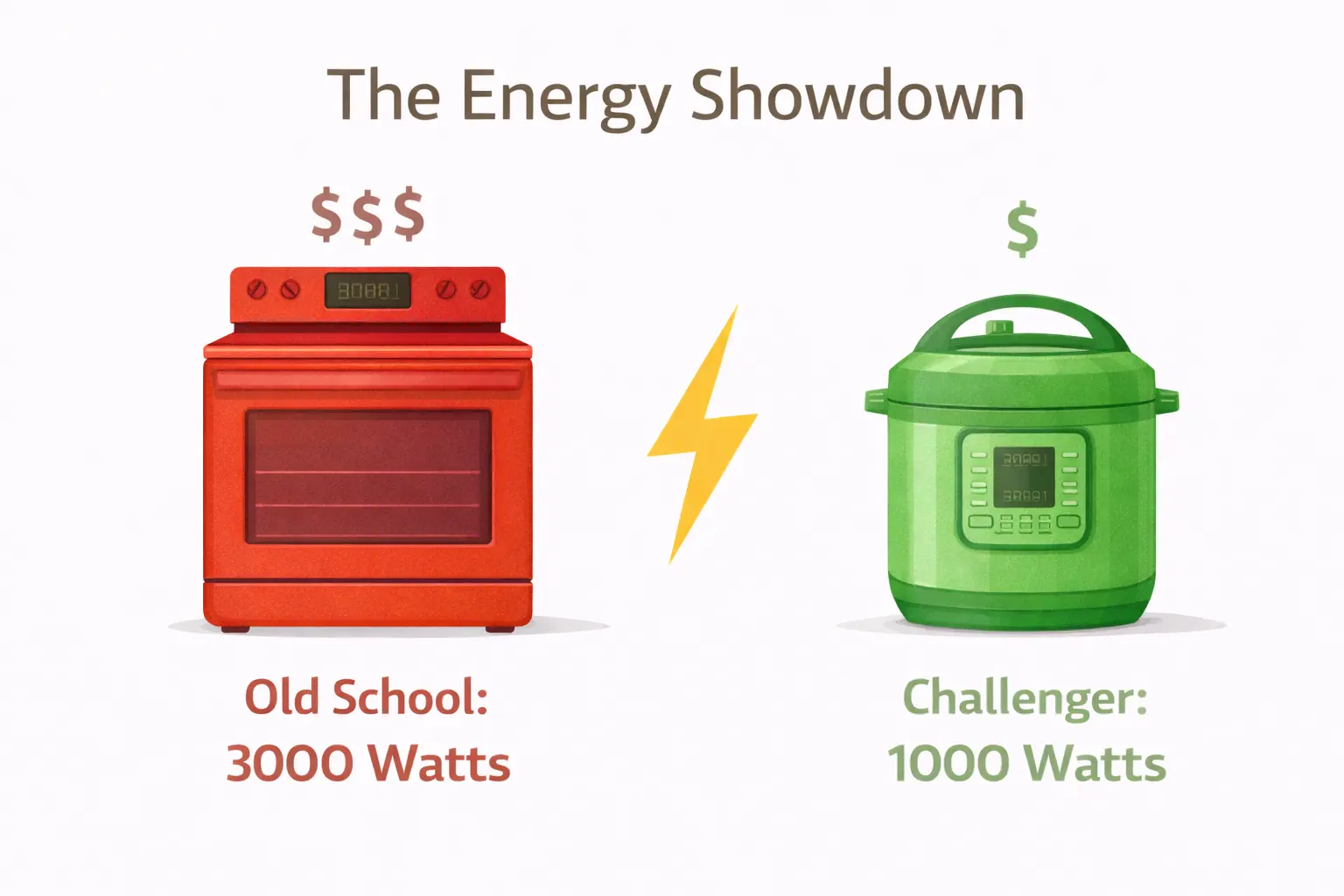
An oven may run at 3,000 watts, but it loses heat continuously and requires long preheating. An air fryer heats a small chamber and cooks faster.
For single meals, roasting vegetables, or reheating, the energy difference is dramatic. Read more about microwave vs oven energy comparison.
Why Wattage Alone Is Misleading
A 1,800-watt air fryer sounds power-hungry. But power draw is only half the equation.
Energy Cost = Power (Watts) × Time (Hours)
The Reality:
• Oven: 3,000W × 45 mins = High Cost
• Air Fryer: 1,800W × 12 mins = Low Cost
The air fryer wins by a wide margin because it cuts the time variable in half (or better).
Best Non-Toxic Ceramic Air Fryers (2026 Picks)
These picks focus on material transparency, not marketing language. Always verify current specs before purchasing.
1. Ceramic-Coated Basket with Stainless Interior
Best for: Daily family cooking with moderate portions.
- The Build: PTFE-free ceramic coating on the basket, with stainless steel interior walls.
- Why it wins: It offers balanced durability and easy cleanup. You get the safety of ceramic without the food sticking frustration of pure steel.
2. Fully Stainless Steel Air Fryer
Best for: Long-term minimalism and zero coating exposure.
- The Build: No coating at all. Heavy construction.
- Why it wins: Commercial-style durability. It will never peel, chip, or off-gas. You will need to use parchment paper or oil to prevent sticking, but the lifespan is indefinite.
3. Hybrid Design (Ceramic Tray + Steel Chamber)
Best for: Easy cleanup without sacrificing lifespan.
- The Build: Ceramic where food touches (the tray), steel everywhere else.
- Why it wins: It minimizes the coated surface area while keeping the "non-stick" convenience where you actually need it.
Who Should Switch?
Is a non-toxic air fryer right for your kitchen?
✅ You SHOULD switch if... ▼
- You cook small portions frequently.
- You use your oven mainly for reheating (air fryers are far superior).
- You care about long-term material exposure and want to eliminate PTFE.
- You want to reduce energy waste in your home.
❌ You might NOT need one if... ▼
- You typically batch-cook large meals for a big family.
- You already use a convection oven efficiently.
- You rarely cook at high heat (above 350°F).
The Takeaway
Non-toxic air fryers aren’t about fear—they’re about informed tradeoffs.
Ceramic and stainless steel options eliminate fluorinated coatings completely. Air fryers often reduce energy use dramatically compared to ovens. When you look at materials + electricity together, the choice becomes clear.
The sticker price isn’t the full cost. A cheaper air fryer that peels and needs replacing every 2–3 years often costs more long-term than a higher-quality ceramic or steel unit that lasts a decade. Choose materials that last. Learn more about home energy improvement credits in our blog.