Microwave vs Oven Baked Potato: Taste, Nutrition, and Energy Cost

If you’ve ever baked a potato in the oven, you already know the routine: Preheat the oven. Wait. Bake for nearly an hour.
It feels simple—but it’s quietly one of the least energy-efficient ways to cook a single serving of food.
Now compare that to the microwave: No preheat. 5–7 minutes. Fully cooked.
Here’s the surprising part: A microwave-baked potato can cost as little as $0.02 in electricity. The same potato in an oven can cost closer to $0.50.
That’s not an exaggeration. It’s math. Let’s break down what’s actually happening—to taste, nutrition, and your energy bill.
How They Heat Food (Very Differently)
The difference starts with physics.
- Microwave Cooking: Microwaves excite water molecules inside the food itself. Heat is generated internally, little energy is wasted heating air, and cooking starts instantly.
- Oven Cooking: Ovens rely on hot air and radiant heat. The entire oven cavity must be heated, most of that heat never touches the food, and heat is continuously lost through walls and vents.
This fundamental difference explains everything that follows.
Taste & Texture: Which Is Better?
Let’s be honest: texture matters. The oven wins on skin, but the microwave wins on convenience.
| Feature | Microwave Method | Oven Method |
|---|---|---|
| Texture | Moist interior, soft skin | Fluffy interior, crisp/dry skin |
| Cook Time | 5–7 Minutes | 50–60 Minutes (+ Preheat) |
| Pros | Fast, retains moisture | Classic "Steakhouse" style |
| Cons | Skin can be chewy/steamed | High energy cost, easy to dry out |
The Hybrid Solution
Most people miss the best option: Combo-Cooking.
- Microwave the potato until tender (5 mins).
- Finish for 5–10 minutes in a hot oven or air fryer to crisp the skin. You get the oven texture without paying the full oven energy cost.
Does the Microwave Destroy Nutrients?
This myth refuses to die. In reality, microwaving often preserves nutrients better than oven baking.
Vitamin C and B vitamins are sensitive to heat and water. Because microwaves cook faster and don't require boiling water, there is less time for nutrients to degrade. A potato cooked in 6 minutes typically retains more nutrients than one cooked for an hour—regardless of the method.
The Real Energy Math (Step by Step)
Let’s look at the receipts. Why is the gap so big?
⚡ The Microwave
Power: ~1,200 watts
Time: 6 mins (0.1 hours)
1,200 W × 0.1 h = 0.12 kWh
Cost ≈ $0.02
🔥 The Oven
Power: ~3,000 watts
Time: 60 mins (incl. preheat)
3,000 W × 1 h = 3.0 kWh
Cost ≈ $0.48–$0.50
Calculated at average rate of $0.16 per kWh.
The gap isn’t subtle. It’s 25× more energy for the oven.
Why Ovens Are So Inefficient for Small Jobs
Ovens are designed for large meals, multiple dishes, and batch cooking. They are terrible at single servings.
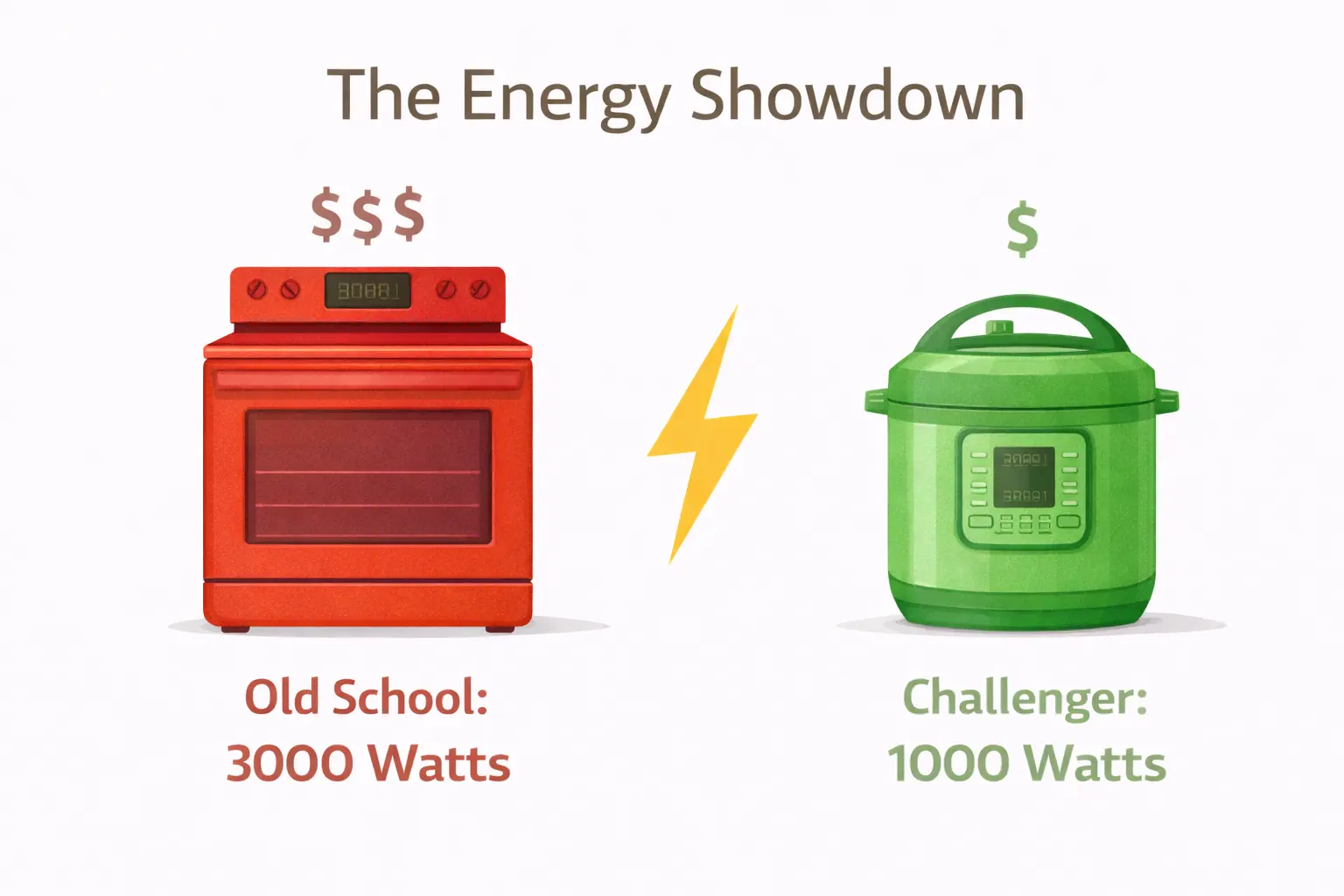
This inefficiency is the exact same reason air fryers use less energy than ovens. It’s why small, targeted cooking appliances always outperform large cavity ovens for single servings or quick meals—no extra space to heat, no excess energy wasted.
When the Oven Still Makes Sense (And Its Limitations)
Of course, the oven isn’t useless. It shines for roasting a pan of vegetables, baking a cake, or cooking a whole chicken—batch cooking where the energy cost is spread across multiple servings. For these big jobs, the oven’s total energy per serving is actually competitive.
But the oven’s biggest limitation isn’t just inefficiency—it’s its complete reliance on electricity (for electric ovens) or a steady gas supply paired with electricity (for gas ovens, which need power for igniters and controls). This means when the grid goes down, your oven is likely useless.
If you’ve ever wondered what happens when electricity isn’t available for your cooking appliances, it’s a critical consideration for anyone looking to build a more resilient kitchen—especially for simple meals like a baked potato that don’t need a full oven in the first place.
Your Kitchen Isn’t Average
Electricity rates vary. Appliance wattage varies. That’s why blanket advice ("always use the microwave") only goes so far.
The Takeaway
A baked potato is a perfect example of how intuition fails with energy use. The oven feels "normal," and the microwave feels like a shortcut.
But when you look at cooking physics, nutrient retention, and electricity cost, the microwave isn’t a compromise—it’s often the smarter tool.
The Pro Move: Microwave for 6 minutes, then pop it in the air fryer for 3 minutes to crisp the skin. You save $0.45 and still get a perfect potato.