⚡ How much does an air fryer actually save vs your oven?
Enter your appliances and recipe time — get exact electricity cost and annual savings.
Walk into any kitchen store and you'll find air fryers labeled "non-toxic," "PFOA-free," and "ceramic-coated" — often on the same product. These terms sound reassuring but mean very different things, and at least one of them is almost meaningless as a safety indicator.
The short version: PFOA-free does not mean PTFE-free, and most air fryers sold as "non-toxic" still use PTFE-based coatings.
This guide explains what the labels actually mean, what genuinely non-toxic options look like, which specific products we recommend, and whether the energy savings make an air fryer worth buying regardless of the coating question.
The Coating Problem: PTFE, PFOA, and Ceramic Explained
PTFE (Polytetrafluoroethylene) — The Core Issue
PTFE is the chemical name for Teflon. It creates a slick, food-release surface and has been used in cookware since the 1950s. At normal cooking temperatures (under 400°F), PTFE is chemically stable and generally considered safe.
The problem is high-heat degradation. Above approximately 500°F, PTFE begins to break down and release fumes. Air fryer heating elements can create localized hotspots above the basket's temperature setting, particularly near the element itself. A basket set to 400°F may have localized areas exceeding 500°F.
This risk increases significantly when:
- The coating is scratched or chipped (degradation occurs at lower temperatures)
- The appliance is used at maximum temperature settings repeatedly
- The coating is old and has been through hundreds of heating cycles
PFOA (Perfluorooctanoic Acid) — Already Gone
PFOA was used in the manufacturing process for PTFE coatings. It has been phased out by major manufacturers and is no longer used in products sold in the US, EU, or most markets.
"PFOA-free" is now the baseline standard — not a safety feature. Every air fryer sold today is PFOA-free. Labeling a product PFOA-free while still using PTFE is technically accurate but functionally misleading.
If the product only says PFOA-free and doesn't explicitly say PTFE-free, assume it contains PTFE.
What "Ceramic" Actually Means
True ceramic coatings are silica-based (derived from sand/minerals). They contain no fluorinated compounds and are genuinely PTFE-free. They work through a different mechanism than PTFE — a naturally hard, slick mineral surface rather than a synthetic polymer.
The problem: "ceramic" is not a regulated term.
Some products marketed as ceramic use a ceramic-look finish applied over a PTFE base layer, or contain ceramic particles mixed into a binding matrix that may include fluorinated compounds. Without third-party material verification or direct manufacturer confirmation, "ceramic" on a label is not a guarantee of PTFE-free construction.
What to look for:
- Explicitly states PTFE-free (not just PFOA-free)
- States 100% ceramic coating or sol-gel ceramic
- Manufacturer provides material safety documentation
Stainless Steel — The Unambiguous Option
Stainless steel baskets have no coating at all. There is nothing to degrade, chip, or off-gas. The tradeoff is that food sticks more readily and cleanup requires more effort (parchment liners help significantly).
For households concerned about any coating exposure, stainless steel eliminates the question entirely.
Ceramic vs Stainless Steel: Which Is Right for You?
| Feature | Ceramic Coated | Stainless Steel |
|---|---|---|
| PTFE content | None (if genuine ceramic) | None |
| Non-stick performance | Good when new | Poor — needs liners or oil |
| Durability | 3-5 years typical | Indefinite |
| Cleanup | Easy | Moderate with liners |
| Long-term cost | Higher (eventual replacement) | Lower (never replace) |
| Best for | Daily convenience cooking | Long-term minimalism |
Best Non-Toxic Air Fryers in 2026
These recommendations prioritize material transparency over marketing language.
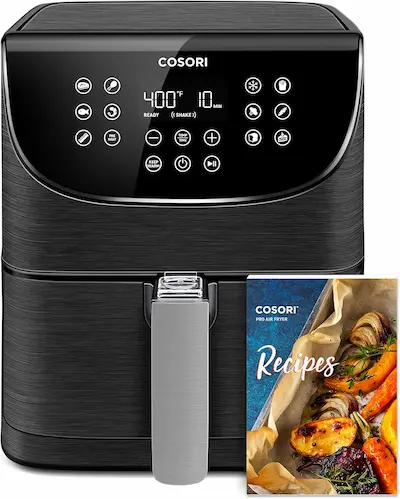
Best Ceramic: Cosori 5.8Qt TurboBlaze
The Cosori TurboBlaze uses a BPA-free, PTFE-free ceramic coating with an explicit manufacturer statement on coating composition — one of the few mainstream brands that provides this directly. The 5.8qt basket handles family portions and the stainless steel interior walls mean only the basket itself has any coating.
Specifications:
- Basket coating: Ceramic (PTFE-free, PFOA-free, BPA-free)
- Interior walls: Stainless steel
- Capacity: 5.8 quarts
- Wattage: 1,750W
- Max temperature: 450°F
- Price range: $85-100
Best for: Daily family cooking, easy cleanup priority, households replacing a traditional PTFE-coated basket.
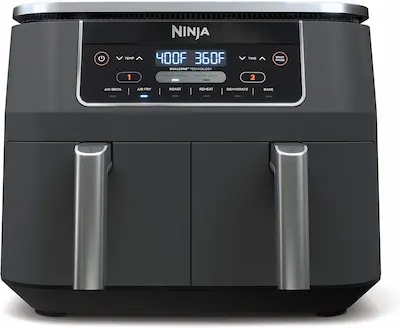
Best Stainless Steel: Ninja Air Fryer Pro XL
The Ninja Pro XL uses a stainless steel crisper plate and basket with zero coating. Food sticks more than ceramic, but using perforated parchment liners (cut to size or pre-cut rounds) solves this almost entirely. The lifespan is indefinite.
Specifications:
- Basket: Stainless steel, no coating
- Capacity: 5.5 quarts
- Wattage: 1,750W
- Max temperature: 400°F
- Price range: $75-95
Best for: Long-term non-toxic use with no coating concerns, households willing to use parchment liners, anyone replacing appliances frequently due to coating wear.
Best Budget Ceramic: Instant Vortex 4Qt
The Instant Vortex 4Qt explicitly states PTFE-free ceramic basket. Smaller capacity limits it to 1-2 person households or side dishes, but the price point makes it an accessible entry into non-toxic air frying.
Specifications:
- Basket coating: Ceramic (PTFE-free)
- Capacity: 4 quarts
- Wattage: 1500W
- Max temperature: 400°F
- Price range: $50-65
Best for: Single or two-person households, first air fryer purchase, budget-conscious buyers.
What to Avoid
Any air fryer that only says PFOA-free (not PTFE-free): This is the baseline standard and tells you nothing about whether PTFE is present. Brands that are genuinely PTFE-free will say so explicitly.
Heavily discounted "ceramic" models from unknown brands: The ceramic coating term is unregulated. Unknown brands without material documentation have no accountability for what their coatings actually contain.
Any basket showing visible scratching or peeling: Regardless of coating type, a damaged coating should be replaced. Scratched ceramic can expose underlying base materials; scratched PTFE creates higher-temperature degradation points.
The Energy Savings Case
Coating safety aside, air fryers represent one of the most significant energy efficiency upgrades available for a home kitchen — particularly for households that use their oven frequently.
The Real Numbers
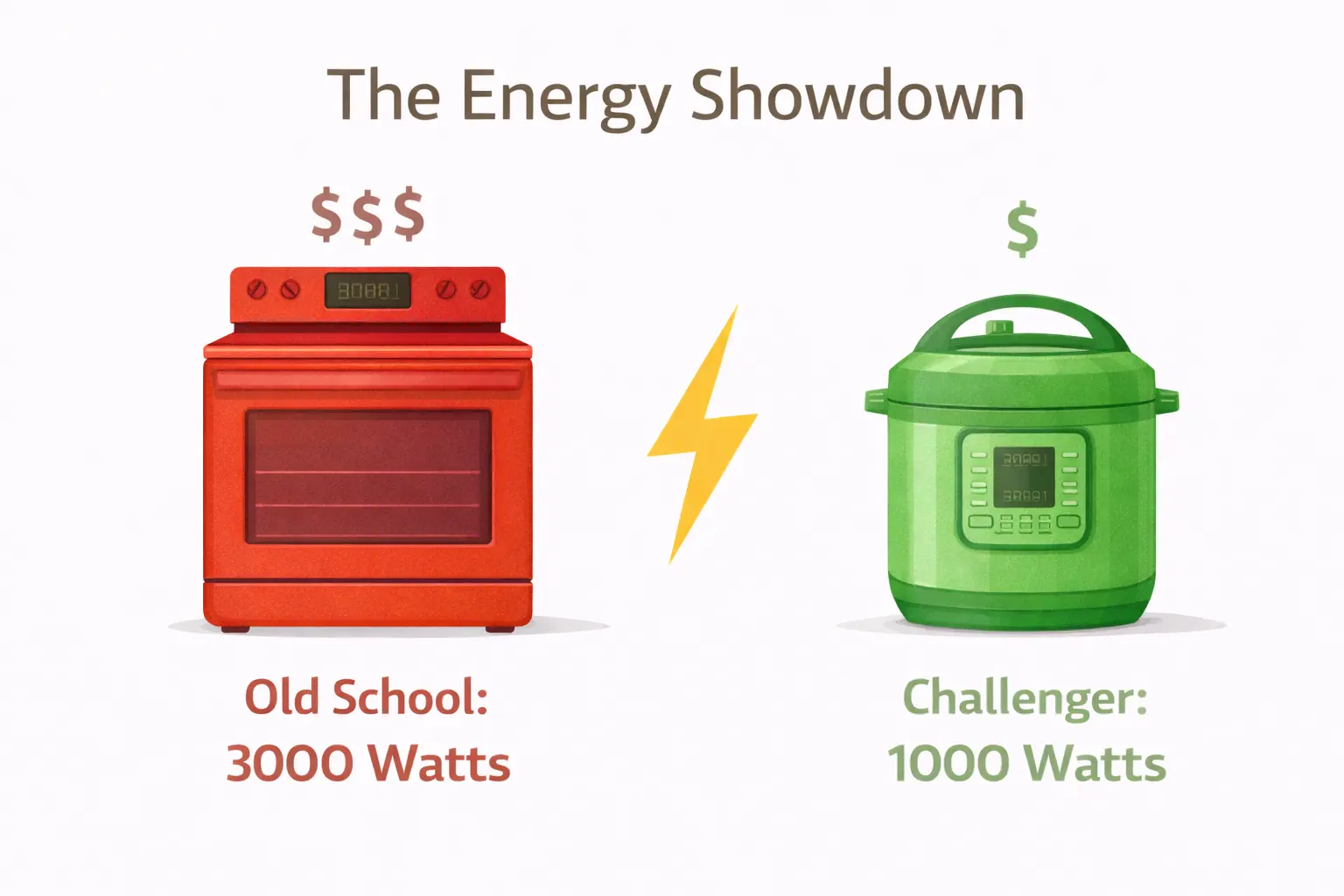
Standard oven:
- Power draw: 2,000-5,000W (varies by element, typically 3000W active)
- Preheat time: 10-15 minutes
- Cook time for chicken thighs: 35-40 minutes
- Total energy: approximately 0.2 kWh preheat + 1.75 kWh cook = ~2.0 kWh
Air fryer:
- Power draw: 1,200-1,800W (typically 1500W active)
- Preheat time: 2-3 minutes
- Cook time for same chicken thighs: 18-22 minutes
- Total energy: approximately 0.05 kWh preheat + 0.5 kWh cook = ~0.55 kWh
Energy savings per use: approximately 70%
At the US average electricity rate of $0.16/kWh, that's $0.23 saved per cooking session. For a household cooking with an air fryer daily: approximately $84/year in electricity savings.
The appliance typically pays for itself within 1-2 years in energy savings alone — before accounting for the reduced need for takeout when reheating is faster and better.
For your specific electricity rate and usage pattern, our Cooking Energy Cost Calculator lets you compare appliances with your exact numbers.
See your exact annual savings before buying.
Enter your oven wattage, air fryer wattage, and how often you cook — get real dollar amounts.
Is a Non-Toxic Air Fryer Worth the Premium?
Standard air fryers with PTFE baskets cost $40-70. Genuine ceramic or stainless options typically run $65-100. The premium is $25-40.
The long-term math:
A PTFE basket typically lasts 2-4 years before coating degradation becomes visible or the non-stick performance drops significantly. At that point, either the basket needs replacement (if available separately, typically $20-40) or the whole appliance does.
A quality ceramic basket lasts 3-6 years. A stainless steel basket lasts indefinitely.
Over a 10-year period, a $90 stainless steel air fryer likely has lower total cost than a $50 PTFE model replaced every 3 years ($50 + $50 + $50 = $150), in addition to eliminating the coating exposure question.
The non-toxic premium is approximately $40 upfront and pays back both financially and in peace of mind over time.
Practical Maintenance to Extend Coating Life
If you already own a ceramic air fryer or are buying one:
Never use metal utensils in the basket. Use silicone or wooden tools only. Metal scratches ceramic coating and creates degradation points.
Hand wash only. Dishwasher detergents are abrasive and accelerate ceramic coating wear. Warm water and a soft sponge after each use.
Avoid cooking sprays. Aerosol cooking sprays leave a residue that builds up on ceramic surfaces and is very difficult to remove. Use a pastry brush to apply oil directly to food instead.
Replace when visibly damaged. Chipped, peeling, or visibly scratched ceramic should be replaced. The underlying base material may not be food-safe, and the degraded coating no longer provides the non-stick benefit anyway.
Store carefully. Stacking metal items in the basket scratches the coating. Store the basket separately or with a cloth between items.
Related Reading
- Cooking Energy Cost Calculator — Calculate exact appliance running costs for your home
- 2026 Home Energy Improvement Tax Credits — Federal credits that may apply to energy-efficient appliance purchases
- Microwave vs Oven Baked Potato Cost — The same energy comparison applied to everyday cooking
- Can You Use a Gas Stove During a Power Outage? — Related energy and appliance safety guide