⚡ See exactly what your oven preheat is costing you.
Enter your oven wattage, preheat time, and local electricity rate to calculate the real cost per cooking session.
Preheating consumes additional energy — but the impact on your electricity bill and your food depends heavily on what you're cooking and what type of oven you have.
For bread, cookies, and pizza: preheat is necessary and the energy cost is worth it. For casseroles, roasted vegetables, and most dense dishes: skipping preheat saves energy without any meaningful quality loss.
How Ovens Consume Energy During Preheat
Ovens heat both the air inside the cavity and the metal walls, racks, and surfaces. All of this must reach the target temperature before any food goes in — and that energy is spent before cooking even begins.
| Oven Type | Typical Wattage | Preheat Time | Energy Used |
|---|---|---|---|
| Conventional | 3000–4500W | 10–15 min | 0.5–1.0 kWh |
| Convection | 2500–4000W | 6–10 min | 0.25–0.67 kWh |
| Toaster oven | 1200–1800W | 5–8 min | 0.1–0.25 kWh |
Preheat to 400°F uses roughly 0.8–1.0 kWh — equivalent to running a microwave for 50–70 meals. For context, see our Air Fryer vs Oven vs Microwave comparison for how preheat affects the full cost-per-meal picture.
When Preheating Is Actually Necessary
Some foods genuinely require a hot oven from the moment they go in.
| Food Type | Preheat Needed | Reason |
|---|---|---|
| Bread / sourdough | ✅ Yes | Oven spring requires immediate heat |
| Cookies | ✅ Yes | Even rise and crust formation |
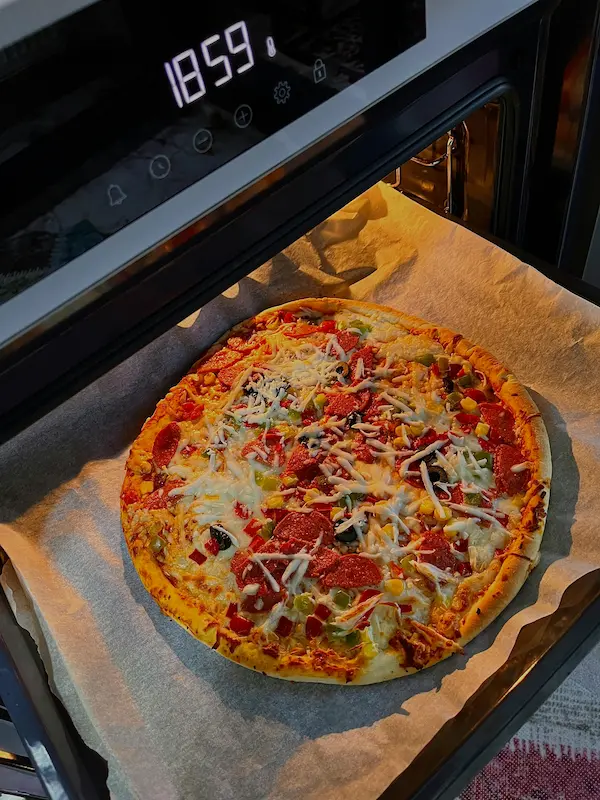
| Pizza | ✅ Yes | Crispy base needs hot surface |
| Pastry / croissants | ✅ Yes | Laminate layers need sudden heat |
| Frozen meals | ✅ Yes | Even heating from cold center |
For sourdough specifically, a preheated Dutch oven or baking surface is critical for proper oven spring — the reason your loaf gets its final rise in the oven. See our Sourdough Poke Test guide for how fermentation and baking temperature interact.
When You Can Skip Preheating
Many common cooking tasks produce identical or nearly identical results without preheat.
| Food Type | Skip Preheat? | Notes |
|---|---|---|
| Casseroles / lasagna | ✅ Safe | Add 5–10 min to total time |
| Roasted root vegetables | ✅ Often fine | Slightly less initial caramelization |
| Large roasts | ✅ Yes | Benefits from gradual temperature rise |
| Reheating leftovers | ✅ Yes | No quality difference |
For roasted vegetables: placing in a cold oven and roasting as it heats produces soft, well-cooked vegetables with slightly less exterior caramelization. Whether that matters depends on your preference.
Preheat Energy by Oven Wattage
| Oven Wattage | 10-Minute Preheat Energy |
|---|---|
| 1200W (toaster oven) | 0.20 kWh |
| 2500W | 0.42 kWh |
| 3500W | 0.58 kWh |
| 4500W | 0.75 kWh |
Longer preheat equals higher cost — and higher target temperatures require longer preheat times.
Convection vs Conventional Oven
Convection ovens circulate hot air with a fan, achieving faster and more even temperature distribution. This reduces preheat time by 25–40% and allows cooking at 25°F lower than conventional recipes specify.
| Oven | Energy per Session | Cost at $0.16/kWh |
|---|---|---|
| Conventional 3000W | 0.60 kWh preheat | $0.096 |
| Convection 3000W | 0.36 kWh preheat | $0.058 |
| Toaster oven 1500W | 0.18 kWh preheat | $0.029 |
For small portions (1–2 servings), the toaster oven or air fryer is almost always the more economical choice. See our Air Fryer vs Oven guide for the full comparison including cooking time.
Cumulative Weekly Savings
Small changes compound over time:
| Scenario | Weekly Preheat Energy | Weekly Cost |
|---|---|---|
| Preheat every cooking session | ~3.0 kWh | ~$0.48 |
| Skip preheat for 50% of meals | ~1.5 kWh | ~$0.24 |
| Use convection for all baking | ~1.0–2.0 kWh | ~$0.16–0.32 |
Over a full year, cooking habits that reduce preheat use can save $25–50 in electricity — modest individually, but the same logic applies across all kitchen appliances.
Practical Tips to Reduce Preheat Energy
- Use convection mode whenever possible — faster preheat, lower temperature needed
- Only preheat for foods that genuinely need it (bread, cookies, pizza)
- For casseroles and roasts, start in a cold oven and add 10% to cooking time
- Avoid opening the oven during cooking — each door opening loses 25–50°F
- Batch cook when the oven is already hot — cook multiple items per preheat cycle
The Batch Cooking Multiplier
The most frugal oven strategy: never run a preheat cycle for a single item.
One preheat cycle amortized across multiple trays of food costs far less per portion than preheating repeatedly for single items. Cook a week's worth of roasted vegetables, sheet pan proteins, or baked goods in a single oven session.
This is why meal prep and batch cooking reduce kitchen electricity costs beyond just the savings from individual technique choices.
Related Reading
- Air Fryer vs Oven vs Microwave: Which Really Costs Less to Run? — Exact cost comparisons for everyday cooking tasks with real wattage data
- Microwave vs Oven Baked Potato: Taste, Nutrition, and Energy Cost — Side-by-side cost breakdown that shows when preheating is worth it
- 2026 Home Energy Improvement Tax Credits — What qualifies for credits and how efficient appliances reduce long-term energy use
- Can You Use a Gas Stove During a Power Outage? — Safety rules and carbon monoxide awareness for gas cooking
- Best Non-Toxic Ceramic Air Fryers (2026) — What PTFE-free actually means and which energy-efficient models are worth buying