The Master Rice Ratio Chart: Stovetop, Pressure Cooker & Steam

Rice should be simple. And yet, almost everyone has a rice story that ends with a pot that’s either soggy, scorched, or stubbornly crunchy in the middle.
What makes this especially frustrating is that the advice feels confident but contradictory.
- “Two cups of water for one cup of rice.”
- “Use the knuckle method.”
- “My grandma never measured anything.”
And sometimes it works. Until it doesn’t.
The truth is, rice isn’t picky—but it is physical. Water ratios depend on evaporation, grain structure, and cooking method. Once you understand those three things, rice stops feeling mysterious and starts behaving predictably.
This guide pulls everything together into one place: a master rice-to-water ratio reference, with explanations that actually make sense in a home kitchen.
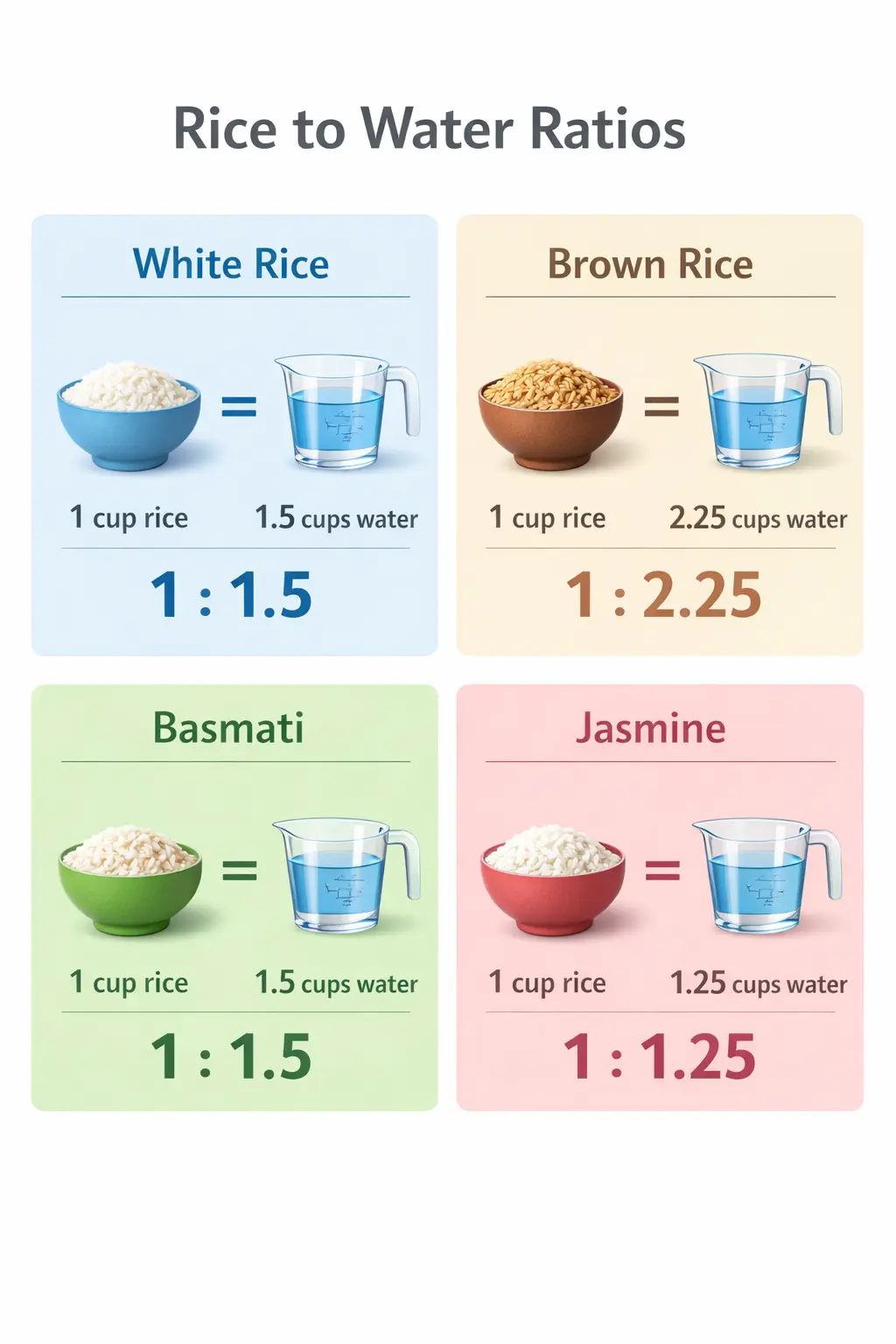
The Master Chart (Save This)
Before we dive into the science, here is the visual reference guide.
Why the “Knuckle Method” Fails (The Physics of Evaporation)
The knuckle method—adding water until it reaches your first knuckle above the rice—is one of the most widely shared rice tips in the world. It also fails more often than people admit.
Why? Because it ignores surface area and evaporation rate.
Here’s what’s actually happening when rice cooks on the stovetop:
- Rice absorbs a fixed amount of water internally (usually 1:1).
- Additional water is lost to evaporation.
The amount of water lost depends on:
- Pot width: A wide pot loses more water than a narrow one.
- Lid tightness: A loose lid leaks steam.
- Heat level: High heat drives off moisture faster.
The knuckle method assumes all kitchens and pots behave the same way. They don’t. Water ratios only work when they account for evaporation—or eliminate it entirely (like in a pressure cooker).
Long Grain Giants: Basmati vs. Jasmine
Not all long-grain rice behaves the same, even if it looks similar in the bag.
🇮🇳 Basmati Rice (Ratio 1 : 1.5)
Basmati has long, slender grains and high amylose content. It tends to elongate rather than swell.
- The Secret: It benefits from rinsing and a 20–30 minute soak. This reduces surface starch and allows grains to lengthen without splitting.
- Stovetop Ratio: 1 cup rice : 1.25–1.5 cups water.
- Warning: Too much water causes burst grains and a mushy texture.
🇹🇭 Jasmine Rice (Ratio 1 : 1.5)
Jasmine rice is slightly stickier and has more amylopectin. It swells rather than elongates.
- The Secret: It doesn’t need soaking, but it does need a bit more water to soften fully.
- Stovetop Ratio: 1 cup rice : 1.5 cups water.
(Read more: Basmati vs. Jasmine: What’s the Difference?)
Short Grain & Specialty Rice Ratios
Shorter grains behave differently because they release starch more readily during cooking.
🍣 Sushi Rice (Ratio 1 : 1.25)
Sushi rice needs enough water to gelatinize starch but not so much that grains burst.
- The Risk: Too much water = porridge. Too little = chalky centers.
- Stovetop Ratio: 1 cup rice : 1.2–1.3 cups water.
🌾 Brown Rice (Ratio 1 : 2.25)
Brown rice still has its bran layer, which slows water absorption and increases cooking time drastically.
- Stovetop Ratio: 1 cup brown rice : 2–2.25 cups water.
- Note: This varies heavily by brand and freshness.
🌿 Seeraga Samba / Jeera Rice (Ratio 1 : 1.5)
This aromatic South Indian rice is gaining attention. It has small grains that cook fast.
- Stovetop Ratio: 1 cup Seeraga Samba : 1.5 cups water.
- Tip: Getting this right preserves its fragrance without turning it sticky.
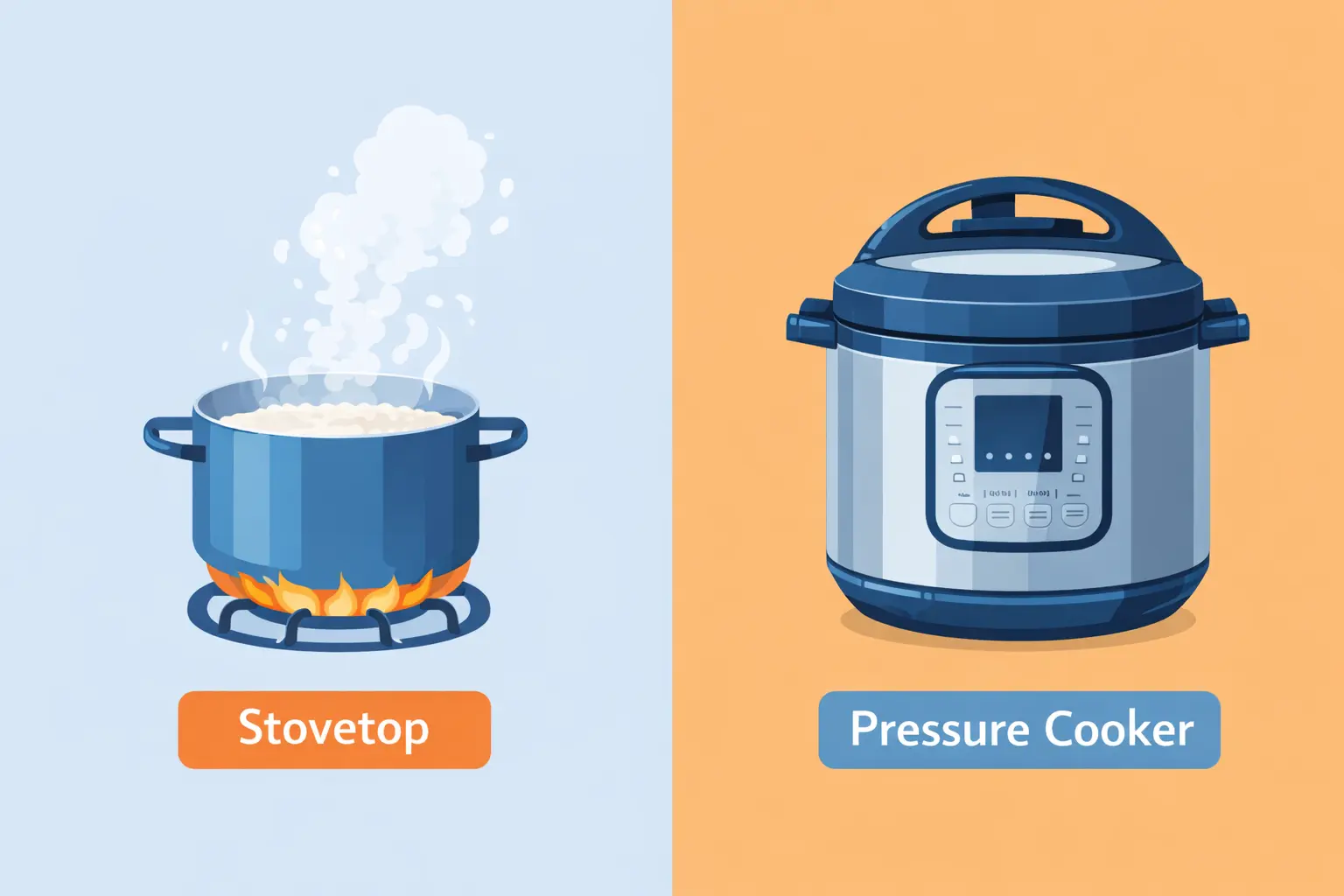
Pressure Cooker vs. Stovetop: Why the Numbers Change
If you’ve ever used the same ratio in an Instant Pot and ended up with soup, this is why.
Pressure cookers operate in a sealed environment. That means almost zero evaporation. Water that would normally escape as steam stays in the pot.
Instant Pot Ratios (General Rule)
- White Rice: 1 : 1
- Jasmine/Basmati: 1 : 1
- Brown Rice: 1 : 1.25
These ratios feel too low if you’re used to stovetop cooking—but they work because the system is closed.
(For a deep dive, see: Pressure Cooker Rice: Why Ratios Change)
What’s Really Happening Inside the Pot
Rice cooking is about starch gelatinization.
As rice heats, starch granules absorb water, swell, and soften. At a certain temperature (usually around 180°F), they release starch.
- Too little water: Incomplete gelatinization (crunchy center).
- Too much water: Excess starch release (gluey texture).
The goal is enough water for full gelatinization without flooding the grains.
Troubleshooting: Too Wet or Too Dry?
Rice problems are usually consistent—and fixable.
Problem 1: Rice is Mushy or Wet
- Likely Causes: Too much water, too much agitation (stirring), or overcooking.
- The Fix: Reduce water slightly next time. For now, let rice rest uncovered for 5–10 minutes to steam off excess moisture.
- (Deep Dive: Why Rice Turns Mushy)
Problem 2: Rice is Dry or Crunchy
- Likely Causes: Not enough water, heat too high (boiled off water too fast), or lid lifted too often.
- The Fix: Sprinkle 2-3 tablespoons of hot water, cover tightly, and steam on low for 5 more minutes.
Problem 3: Rice Sticks to the Bottom
- Likely Causes: Heat too high or a thin-bottomed pot creating hot spots.
- The Fix: Lower heat immediately after boiling. Use heavy-bottomed cookware.
Does Rice Age Matter?
Yes—and more than most people realize.
Fresh rice (New Crop) contains more internal moisture. As rice ages, moisture content drops, and water absorption increases. That’s why an older bag of rice may suddenly need more water than usual.
(Read more: Does Rice Age Matter for Cooking?)
Frequently Asked Questions
Do I really need to wash rice? ▼
Why is my brown rice always hard? ▼
What is the ratio for Seeraga Samba rice? ▼
The Takeaway
Perfect rice isn’t about tradition or intuition. It’s about grain structure, water absorption, and evaporation control.
Once you understand those, the ratios stop feeling arbitrary—and rice becomes one of the most reliable things you cook. Consistency beats mystery every time.