⚡ Get your exact Instant Pot ratio right now.
Select Instant Pot mode — the calculator adjusts water amount automatically for any rice type and batch size.
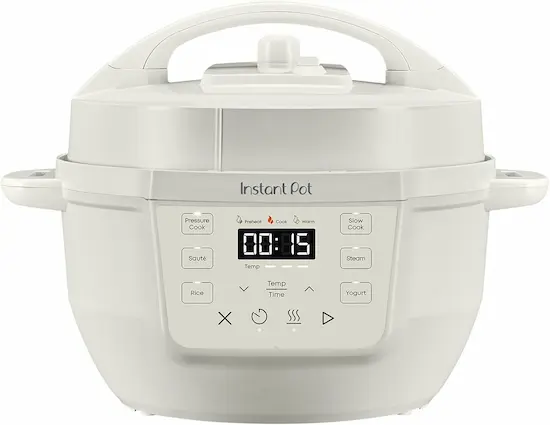
The Instant Pot is marketed as a foolproof rice cooker. Push a button. Walk away. Perfect rice.
In reality, Instant Pot rice fails more often than stovetop rice for first-time users — and almost always for the same reason: they used the wrong water ratio.
The mistake is understandable. Every rice recipe you've ever used was written for stovetop. Those ratios are wrong for pressure cookers. Not slightly wrong — significantly wrong. Using stovetop water amounts in an Instant Pot produces overcooked, mushy, or scorched rice because the physics of cooking under pressure are fundamentally different.
This guide explains exactly why the ratio changes, gives you precise amounts for every rice type, and covers the release method and timing variables that determine whether your rice comes out fluffy or gummy.
Why Instant Pot Rice Needs Less Water: The Physics
On the stovetop, water evaporates continuously throughout cooking. This is why stovetop white rice uses a 1:1.5 or 1:2 ratio — a significant portion of that water never enters the rice grain. It escapes as steam.
The Instant Pot is a sealed system. When you lock the lid and set it to pressure cook, almost no water escapes. The water that would have evaporated on the stovetop stays inside the pot.
This means:
- Stovetop white rice at 1:1.5 → rice absorbs ~1 cup, ~0.5 cups evaporate
- Instant Pot white rice at 1:1.5 → rice absorbs ~1 cup, ~0.5 cups remain as liquid
That remaining liquid is what produces mushy, waterlogged rice. The grain absorbs as much as it can, then sits in excess water while the residual heat continues cooking it.
The correct Instant Pot ratio eliminates the evaporation allowance entirely. Use only the water the rice will actually absorb.

Instant Pot Rice Ratios by Rice Type
These ratios are for rinsed rice in a standard electric pressure cooker (Instant Pot Duo, Pro, Ultra, or equivalent). All use High Pressure setting.
| Rice Type | Ratio (Rice:Water) | Cook Time | Release Method |
|---|---|---|---|
| White Long-Grain | 1 : 1 | 3 minutes | Natural 10 min |
| Jasmine Rice | 1 : 1 | 3 minutes | Quick Release |
| Basmati Rice | 1 : 1 | 4 minutes | Natural 10 min |
| Sushi / Short-Grain | 1 : 1 | 3 minutes | Natural 10 min |
| Brown Long-Grain | 1 : 1.25 | 22-24 minutes | Full Natural |
| Brown Basmati | 1 : 1.15 | 22 minutes | Full Natural |
| Wild Rice Blend | 1 : 1.25 | 25 minutes | Full Natural |
| Quinoa | 1 : 1.25 | 1 minute | Natural 10 min |

💡 Aromatic varieties (Seeraga Samba, aged basmati): These may need even less water — as little as 0.9:1 — due to lower moisture content from aging. If your aromatic rice consistently comes out sticky, reduce water by 2 tablespoons per cup and test. See our Seeraga Samba guide for specifics.
Natural Release vs Quick Release: Why It Matters
The release method is the second variable that determines rice texture — almost as important as the water ratio.
Natural Release (NR)
After the cook time ends, you do nothing. The pot depressurizes on its own over 10-20 minutes. During this time, the rice continues cooking gently from residual steam and heat.
When to use: White long-grain, basmati, brown rice, wild rice blends. Natural release allows moisture to redistribute evenly through the grain, producing fluffier texture with distinct, separate grains.
Full Natural Release: You wait until the float valve drops completely on its own — typically 15-20 minutes. Required for brown rice because the bran layer needs the additional steam time to finish softening.
Quick Release (QR)
You manually flip the steam release valve to Venting immediately after the cook time ends. Pressure releases in 1-2 minutes.
When to use: Jasmine rice specifically benefits from Quick Release. Jasmine is a high-starch variety that becomes sticky and clumped if it continues cooking in residual steam. Quick Release stops the cooking process at exactly the right moment.
Never Quick Release brown rice. The rapid depressurization interrupts the bran softening process and produces grains with hard, chewy centers that look done but aren't.
The 10-Minute Natural + Quick Release (Standard White Rice)
For most white rice: let the pot Natural 10 min, then flip the valve to release any remaining pressure. This gives enough steam time for even moisture distribution without overcooking.
Total Time Comparison: Instant Pot vs Stovetop
A common misconception is that Instant Pot rice is dramatically faster. For white rice, the time is actually similar when you include pressurization.
| Method | White Rice | Brown Rice |
|---|---|---|
| Stovetop | 20-22 minutes | 45-50 minutes |
| Instant Pot | ~25 minutes total* | ~50-55 minutes total* |
*Includes 10-12 minutes for pressurization plus cook time plus release time.
Where Instant Pot wins on time: Brown rice. The pressure environment softens the bran layer more efficiently than stovetop steam, reducing cook time by roughly 20-25% while being completely hands-off.
Where stovetop wins: Small batches of white rice (1-2 cups). The Instant Pot overhead — pressurization, release, cleanup — adds time that doesn't make sense for a quick weeknight side dish.
Cooking a different rice type or unusual batch size?
The calculator adjusts ratio, water amount, and cooking notes automatically for every rice type and device.

The Burn Error: Causes and Prevention
The Burn error (displayed as "Burn" or "OvHt" on some models) occurs when the sensor detects the bottom of the inner pot overheating before sufficient steam builds to pressurize.
Cause 1: Insufficient water
The most common cause. If you use slightly less water than the ratio calls for, the bottom layer of rice can dehydrate and scorch before the pot pressurizes. Solution: measure water precisely. Do not eyeball it.
Cause 2: Residue from previous cooking
If you cooked something with sugars, starches, or proteins before the rice — even if you rinsed the pot — residue can stick to the bottom and trigger the sensor. Solution: deglaze the pot with 2-3 tablespoons of water and scrape any stuck bits before adding rice and water.
Cause 3: Surface starch from unrinsed rice
Unrinsed rice releases surface starch immediately when water is added. This starch gelatinizes quickly at the bottom of the pot before pressurization, creating a scorched layer. Solution: rinse rice under cold water until the water runs mostly clear — typically 2-3 rinses.
Cause 4: Thick sauces or seasonings in the pot
Soy sauce, tomato paste, coconut milk, or other thick liquids added directly to the pot can trigger Burn because they don't produce steam as efficiently as plain water. Solution: add plain water first, then add any sauces on top of the rice without stirring, or use the pot-in-pot method.
Prevention rule: 1 tablespoon of oil or butter in the pot before adding rice and water creates a non-stick layer on the bottom that significantly reduces Burn risk.
Common Instant Pot Rice Mistakes
Using the Rice button for all rice types
The Rice button is programmed for white medium-grain rice at a specific quantity. It produces unreliable results for brown rice, aromatic varieties, or non-standard batch sizes. Use Manual / Pressure Cook mode and set times yourself.
Stirring after cooking
Stirring hot rice releases trapped starch and turns separate grains into a gummy mass. Fluff only — use a fork and lift gently rather than mixing.
Opening the lid immediately after cook time
Even for Quick Release rice, let the pot sit for 2 minutes after the float valve drops before opening. This final rest allows surface moisture to distribute into the grain.
Not rinsing the rice
Surface starch on unrinsed rice produces sticky, clumped results and increases Burn risk. The 60 seconds of rinsing is worth it for every rice type.
Cooking very small batches
The Instant Pot is designed for minimum quantities — typically 1 cup of dry rice minimum for reliable pressurization. Smaller batches produce inconsistent results because there may not be enough liquid to generate sufficient steam.
Instant Pot Rice for Meal Prep
The Instant Pot's true advantage for rice is batch cooking. White rice keeps refrigerated for 4-5 days and freezes well for up to 3 months. Brown rice keeps refrigerated for 3-4 days.
Batch cooking approach:
Cook 4-6 cups of dry rice at once (ratio scales directly — 4 cups rice + 4 cups water for white rice). Portion into meal-prep containers immediately after fluffing, while hot. Let cool uncovered for 10 minutes before sealing to prevent condensation from making the rice wet.
Reheating: Add 1 tablespoon of water per cup of cooked rice before microwaving, or reheat in the Instant Pot using the Steam function for 1-2 minutes.
Instant Pot vs Rice Cooker: Which Produces Better Rice?
Both produce good rice. The choice depends on how you use your kitchen.
Instant Pot advantages:
- Multifunctional — also cooks beans, soups, meats, grains
- Better for brown rice (faster, more consistent)
- Better for batch cooking large quantities
Dedicated rice cooker advantages:
- Simpler to use — no manual pressure settings
- Better at keeping rice warm for extended periods without drying
- More consistent for daily white rice cooking (especially Aroma models)
- Takes up less counter space
For households that cook rice daily and primarily eat white rice, a dedicated rice cooker (Aroma or Zojirushi) produces slightly better results with less thought. For households that cook rice a few times per week alongside other Instant Pot cooking, the Instant Pot is the better value.
See our complete rice water ratio guide for stovetop and rice cooker ratios alongside the Instant Pot comparisons.
Fixing Bad Instant Pot Rice
Rice is mushy:
- Drain any visible excess water immediately
- Spread rice on a baking sheet and bake at 300°F for 5-8 minutes to evaporate excess moisture
- Or use for fried rice — day-old mushy rice fries better than fresh rice
- Next time: reduce water by 2 tablespoons per cup
Rice is undercooked or has hard centers:
- Add 2-3 tablespoons of water to the pot
- Seal lid and cook on High Pressure for 1-2 additional minutes
- Full Natural Release
- Next time: increase cook time by 1-2 minutes or use Natural Release instead of Quick
Rice is sticking together in clumps:
- Almost always caused by insufficient rinsing or stirring after cooking
- Next time: rinse until water runs clear and fluff with fork — never stir
Bottom layer is scorched:
Scrape and discard the scorched layer
The rest is usually fine to eat
Next time: add 1 tablespoon oil before cooking and deglaze the pot
Related Reading
- Complete Rice Water Ratio Chart — Every rice type, every cooking method
- Rice Cooker Water Lines vs Measuring Cups — The contrast that explains why pressure cooker ratios feel so different from rice cooker logic
- Does Rice Age Matter? — Why old rice needs more water in any device
- Basmati vs Jasmine vs Short-Grain — Why each variety needs a different approach
- Seeraga Samba Rice Guide — Aromatic rice that needs special handling
- Why Rice Turns Mushy — The starch science behind texture problems
- Free Rice Calculator — Instant Pot, stovetop, and rice cooker ratios in one tool