The year I learned recipe scaling the hard way, my kitchen smelled like a science experiment gone wrong. I doubled my sauerkraut batch — same 2% salt ratio, I figured, so I just doubled the spoons. The fermentation stalled. Nothing bubbled. Two weeks later I had a crock of limp, salty cabbage that went straight to the compost.
A month after that, I doubled my sandwich bread recipe and doubled the yeast right along with it. The dough rose like a balloon, then collapsed into a sad, yeasty pancake before it ever hit the oven. Both failures looked like "the recipe didn't work." Both were actually scaling math errors.
Here's the thing I tell every client and every mom who asks: scaling a recipe is not photocopying — flour doubles, yeast doesn't. The same mistake plays out in kitchens across America every weekend, and it's never the recipe's fault.
📏 Need to scale a recipe right now?
Enter your servings and ingredients — the Recipe Scaler multiplies the safe stuff and flags the salt, spice, yeast, fermentation, and oven-time exceptions most calculators ignore.
The One Number That's Actually Safe
Before we get to the messy parts, here's the math every recipe scaler on the internet does:
Scale factor = target servings ÷ original servings
Eight servings divided by four servings? That's 2x. Every ingredient doubles. Done.
This linear multiplication is perfectly safe for a whole category of ingredients: flour, water, sugar, oil, dairy, and vegetables. If a soup calls for 2 cups of carrots and you're doubling it, use 4 cups of carrots. There is no hidden chemistry in carrots.
That's the starting point — not the finish line. Because five things refuse to play by those rules, and they're exactly the things that ruin a doubled batch.
The 5 Things That Don't Scale Linearly
1. Salt — It's a Percentage, Not a Multiple
This is the one that bit me with that sauerkraut. For fermenting and brining, salt is a percentage of the total weight of the other ingredients — not a multiple of servings.
The safe lacto-fermentation line is 2% salt by weight of vegetables. Doubling a sauerkraut recipe and doubling the salt by volume can push you past 3.5%, which stalls fermentation and leaves the batch unsafe — or worse, drop you below 2% when you halve a recipe, and mold wins.
And here's the trap hiding inside volume measurements: Morton and Diamond Crystal kosher salt differ by about 40% per same-volume measure. A tablespoon of Morton weighs about 14g; the same tablespoon of Diamond Crystal weighs about 9g. A "tablespoon of kosher salt" in one cookbook is not the same tablespoon in another. This is exactly why the USDA home-canning guidelines specify salt by weight for brines, not by spoon.
The rule: For brines and ferments, weigh the vegetables, then calculate salt at 2% of that weight. Use the Pickle Brine Calculator to do the math. For ordinary cooking, salt does scale with servings — but measure it by weight anyway. If your pickles have ever come out wrong, the science of salt density and weight explains why.
2. Spices — Heat Compounds Faster Than Volume
Chili heat, clove, and cinnamon don't scale like flour. Capsaicin and volatile oils compound faster than volume — doubling a chili recipe and doubling the cayenne can turn a family dinner into an inedible fire-breather. Doubling cloves in a cake recipe makes it taste like perfume.
The rule: For pungent spices on large jumps, add only about 50% of the scale factor, then taste and adjust. Going from 1 teaspoon of cayenne to 2 teaspoons for a doubled batch? Start with 1½, taste, and decide if you need the rest. You can always add heat. You cannot remove it.
3. Yeast — Exponential, Not Linear
Yeast growth is exponential. The microbes don't need to double when the batch doubles — the same cells simply reproduce to fill the larger dough.
Common baking rule of thumb for home bakers: doubling a recipe means about 1.5x the yeast, and tripling means about 2x. Not 2x. Not 3x.
Doubling the yeast with a doubled batch over-proofs the dough before shaping — that's the collapse I lived through. Flat, sour, yeasty, and completely deflating after a whole afternoon of bread therapy.
The rule: Cut the yeast. Double the batch, use 1.5x the yeast. Triple it, use 2x.

4. Fermentation Time — Microbes Work Per Cell, Not Per Volume
Here's the counterintuitive one: a bigger batch of dough, sauerkraut, or brine ferments at roughly the same rate as a small batch. The microbes don't know they're in a bigger jar. They work per cell, not per volume.
The lever that actually controls fermentation speed is temperature — not batch size. Every 10°F increase roughly doubles fermentation activity; every 10°F decrease roughly halves it. Our bulk fermentation guide explains the full temperature-time relationship.
So when you double a sourdough recipe, do not double the bulk fermentation time. You'll get a flat, sour, over-fermented loaf — the exact failure I described in the opening. Keep the timeline the same, and let temperature, not batch size, be your dial.
5. Oven Time — Watch the Pan, Not the Clock
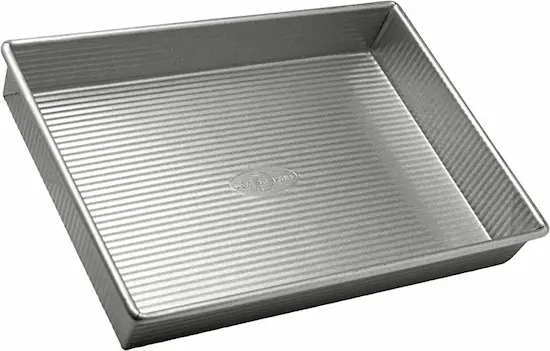
Bake time tracks pan geometry and batter depth, not servings. Doubling a cake recipe into two identical 9-inch round pans bakes in roughly the same time as one cake — because the batter depth hasn't changed. Doubling into one giant pan means deeper batter and a longer bake, but it is not double the time. Pan geometry changes bake time in ways most home cooks never expect.
The reliable way to know? Check center temperature: 200-210°F for cakes. The thermometer doesn't care how many servings you're making. If you're swapping pan sizes entirely, use the Cake Pan Converter to figure out the right bake time adjustment for the new geometry.

Quick Reference: The 5 Rules
| Rule | What to do | Failure if ignored | Source |
|---|---|---|---|
| Salt does not always scale 1:1 | For fermenting and brining, salt is a percentage of the total weight of the other ingredients - not a multiple of servings. Doubling a sauerkraut recipe and doubling the salt by volume can push the batch outside the safe 2% lacto-fermentation line. For table cooking, salt usually scales with servings, but volume measures vary wildly between brands (Morton vs Diamond Crystal kosher salt differ by ~40%). | A doubled sauerkraut batch made with doubled table-salt spoons can climb past 3.5% salt, stalling fermentation or leaving the batch unsafe; a halved batch with the same 1 tsp can fall below 2% and let molds win. | USDA home-canning 2% brine fact |
| Spices and heat do not scale linearly | Chili heat, clove, and cinnamon concentration follow their own curve. Doubling a recipe does not mean doubling cayenne or cloves - volatile oils and capsaicin compound faster than volume. Scale pungent spices by about 50% of the factor for large jumps, then taste. | Doubling a chili recipe with 2x cayenne can turn a family dinner into an inedible fire-breather; doubling cloves can make a cake taste like perfume. | Common baking/spice reference (fom-tool-logic) |
| Yeast should not be doubled with the batch | When you double a yeasted dough, use about 1.5x the yeast, not 2x. Yeast growth is exponential, not linear - the same cells reproduce to fill the larger dough. Common baking rule of thumb: doubling the recipe means about 1.5x yeast; tripling means about 2x yeast. | Doubling yeast with a doubled batch produces an over-proofed, yeasty, collapsing loaf - the dough over-ferments before shaping. | Red Star yeast conversion reference |
| Fermentation time does not scale with batch size | A bigger batch of dough, sauerkraut, or brine ferments at roughly the same rate as a small one - the microbes work per-cell, not per-volume. Temperature, not batch size, is the lever. Do not multiply fermentation or proofing time by the scaling factor. | Doubling a sourdough recipe and doubling the proof time over-ferments the dough - flat, sour, collapsed bread. | Sourdough bulk fermentation guide + lacto-ferment temp range |
| Oven time does not scale with servings | Bake time tracks pan geometry and batter depth, not servings. Doubling a cake into two identical pans bakes in roughly the same time; doubling into one larger pan means deeper batter and a longer bake - but not double. Check doneness with a thermometer (cakes about 200-210F), not the clock. | Scaling a 9x13 cake to 2x and keeping the same bake time under-bakes the center; adding 2x the time over-bakes the edges into a hockey puck. | Cake pan converter + oven temperature sensitivity facts |
How to Scale a Recipe Correctly: 7 Steps
1. Calculate the factor first. Target servings ÷ original servings. This is your baseline, and it's the only number you need to start.
2. Scale most ingredients linearly. Flour, water, sugar, oil, dairy, and vegetables all multiply by the factor. This is the safe, boring math — and it's correct.
3. Hold salt by weight. For brines and ferments, salt is 2% of total batch weight — use the Pickle Brine Calculator. For cooking, salt scales with servings, but weigh it because volume varies wildly between brands.
4. Cut the yeast. Double → 1.5x, triple → 2x. Never the full factor.
5. Add pungent spices to taste. Start at ~50% of the factor for large jumps, taste, then adjust upward.
6. Watch the pan, not the clock. Two identical pans = same bake time. One larger pan = longer, but not double. Use a thermometer: 200-210°F center for cakes.
7. Don't touch fermentation time. A bigger batch ferments at the same rate. Temperature, not batch size, is your lever.

Weigh, Don't Scoop: The Volume Trap
Here's something most American recipes don't warn you about: we measure by volume, while most of the world measures by weight. And scaling is exactly where volume-based error compounds.
A cup of flour can weigh anywhere from 120g to 155g depending on how it's packed — spooned and leveled versus scooped and shaken. At single-batch size, that difference is annoying. Double the recipe, and you're off by 60 grams or more. That's the difference between a tender cake and a brick.
Same story with salt. As we covered, Morton and Diamond Crystal kosher salt differ by about 40% per same-volume measure — 14g versus 9g per tablespoon. At one teaspoon, nobody notices. At two tablespoons scaled from a "trust me" recipe, you've ruined the batch.
This is why I tell every home cook to buy a digital kitchen scale — it's the single cheapest fix for scaling failures. And when you need to convert between volume and weight, use the Cups to Grams Calculator (and for the tablespoon-to-cup conversions, the kitchen conversion guide) instead of guessing. Sticky ingredients like honey are the worst offenders — honey cake collapses when measured by volume.
Scaling Down Is Its Own Trap
Everyone worries about doubling. Halving has its own quiet failures.
First, the spoon problem: half a tablespoon doesn't exist on a standard spoon set. You need 1½ teaspoons. It sounds obvious, and yet every kitchen has a recipe ruined by someone scooping "about half" with a soup spoon.
Second, small-batch yeast measurement is precision-critical. When you're working with fractions of a teaspoon, the conversion math matters:
- 1 teaspoon active dry yeast = 0.75 teaspoon instant yeast
- 1 teaspoon instant yeast = 1.33 teaspoons active dry yeast
These are the traditional conversion ratios home bakers have relied on for years. One honest caveat: with modern production methods, King Arthur and other sources now treat active dry and instant yeast as interchangeable 1:1 — this tool keeps the traditional 0.75/1.33 ratios for precise control. Either approach works for most home bakes; the traditional ratios just give a slightly gentler rise.
Get this wrong at single-batch size and you have sluggish dough or a yeasty mess.
And third, there's the economics of scaling down. Sometimes a half-batch isn't worth the oven preheat. A single-serving casserole costs more per plate than a full one — that's not frugal, that's just math wearing a costume.
When to Make Two Batches Instead
Here's the honest line I've hit as a mom of three and a dietitian: scaling up is not always the frugal move.
Above 4x, you're in the warning zone. A 5x batch is not the same dish — it's a different beast with different geometry, different fermentation times, and different failure modes. "5x is not the same dish" is a phrase I use with clients who think big-batch cooking is always the answer.
If you need twice the cake, bake two cakes in two pans rather than one giant sheet. If you need triple the bread, make two loaves worth of dough in two batches — or one batch plus a starter you feed once. Every time you double the pan size instead of the pan count, you're gambling with center doneness.
And remember the frugal trap: doubling a recipe to save money, then watching it fail — over-salted kraut, collapsed bread, raw centers — the failure isn't the recipe. It's the scaling math. One ruined doubled batch costs more than the two single batches you were trying to avoid making.
FAQ
How do you scale a recipe to a different number of servings? Divide your target servings by the original servings to get the scale factor, then multiply every ingredient amount by that factor. For example, 8 servings divided by 4 servings = 2x, so every ingredient doubles. Use the calculator above to avoid the arithmetic.
Does salt scale linearly when you double a recipe? For brining and fermenting, no — salt is a percentage of total batch weight, so scaling by volume can push you out of the safe 2% lacto-fermentation range. For ordinary cooking, salt scales with servings, but measure by weight because volume differs by brand. Morton and Diamond Crystal kosher salt differ by about 40% per teaspoon.
Should I double the yeast when I double a bread recipe? No. Yeast growth is exponential, not linear. When you double a yeasted dough, use about 1.5x the yeast; when tripling, use about 2x. Doubling the yeast can over-proof the dough and make the loaf collapse. See our sourdough hydration calculator for dough math.
Does baking time double when you double a recipe? No. Bake time tracks pan geometry and batter depth, not servings. Doubling into two identical pans bakes in about the same time; doubling into one larger pan needs more time but not double. Check doneness with a thermometer (cakes about 200-210°F), not the clock. For pan swaps, use our Cake Pan Converter.
Does fermentation time scale with batch size? No. A bigger batch of dough, sauerkraut, or brine ferments at roughly the same rate as a small batch — microbes work per cell, not per volume. Temperature, not batch size, is the lever. Our bulk fermentation guide explains the temperature-time relationship.
The Tools That Do the Math For You
You don't need to memorize all of this — you need to know which number is the exception. That's what the Recipe Scaler is for: it handles the linear math so you can focus your brain on the five exceptions.
And when you hit one of those exceptions, use the right tool:
- Pickle Brine Calculator — for the 2% salt rule
- Cake Pan Converter — for pan geometry and bake time
- Sourdough Hydration Calculator — for dough math and fermentation planning
- Cups to Grams Calculator — for weighing instead of scooping
Because scaling a recipe well isn't about being a human calculator. It's about knowing which ingredients obey the math — and which ones are going to fight you. Flour doubles. Yeast doesn't. Salt is a percentage. And that's the whole secret. Want the pro version of that math? Baker's percentages turn scaling into a recipe in itself.