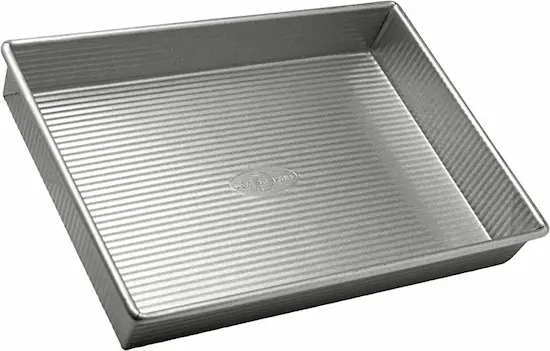
🎂 Switching pan sizes and need the adjusted time?
The calculator does the surface area math and gives you an exact time adjustment — no guessing required.
Every baker has pulled a cake out of the oven at the recipe's specified time only to find a raw center or burnt edges. The recipe wasn't wrong. The pan changed the physics.
Understanding why pan size affects baking time isn't just academic — it's the difference between confidently adapting any recipe to any pan you own, and hoping for the best every time.
The Core Mechanism: Batter Depth Controls Everything
An oven heats food from the outside in. Heat enters through the pan walls and bottom, moves through the batter by conduction, and gradually reaches the center.
The speed of that journey depends entirely on distance.
When you pour the same batter into a larger pan, it spreads thinner. The center is now closer to the heat source. It reaches baking temperature faster. Done sooner.
When you pour the same batter into a smaller pan, it sits deeper. The center is further from the heat source. It takes longer to reach baking temperature. Done later.
This is the complete explanation. Everything else — surface area formulas, time adjustment percentages, temperature changes — is just this principle made precise.
Two Types of Heat Transfer in an Oven
Understanding why edges and bottoms behave differently from centers requires knowing how heat actually moves in an oven.
Conduction: Pan to Batter
The oven element heats the pan. The pan transfers that heat directly into the batter it touches. This is why the bottom and edges of a cake always set first — they're in direct contact with the heat-conducting metal.
What affects conduction:
- Pan material (aluminum conducts faster than glass)
- Pan color (dark surfaces absorb more radiant heat)
- Pan thickness (thicker pans distribute heat more evenly, preventing hot spots)
Convection: Hot Air to Batter Surface
Hot air in the oven rises and circulates, transferring heat to the top surface of the batter. This is slower than direct conduction.
What affects convection:
- Oven type (convection ovens use a fan to force air circulation, cooking faster and more evenly)
- Pan placement (center rack maximizes even airflow on all sides)
- Pan proximity to oven walls (too close = restricted airflow = uneven cooking)
Why This Creates the "Raw Center" Problem
In a deep pan, the bottom and edges conduct heat quickly and begin to set. The center, insulated by the surrounding batter, heats much more slowly via conduction from the sides.
If you bake at high temperature with deep batter, the edges finish — and start to overbrown — while the center is still liquid. The standard fix is to lower temperature and extend time, giving heat time to reach the center before the edges burn.
The deep pan rule
When batter depth increases significantly — moving from a 9x13 to an 8x8, or from a sheet pan to a loaf pan — drop oven temperature by 25°F and extend time by 20-30%. This slows the edge cooking while giving the center time to catch up.
How Pan Material Changes the Equation
The recipe was written with a specific pan material in mind — usually shiny aluminum. Switch materials and the heat dynamics shift.
Shiny Aluminum (the baseline)
Reflects radiant heat. Conducts evenly. The standard assumption for most published baking recipes.
Use as-is. No adjustment needed if the recipe specifies a standard metal pan.
Dark Nonstick
Absorbs significantly more radiant heat from oven walls and element. Bottoms and edges brown faster.
Adjustment: Reduce temperature by 25°F. Check doneness 5-10 minutes early.
Glass (Pyrex)
Absorbs heat slowly but retains it exceptionally well. Continues transferring heat to the batter after you remove it from the oven — carryover cooking is significant.
Adjustment: Reduce temperature by 25°F. Remove from oven when toothpick comes out with a few moist crumbs, not fully clean — it will finish cooking as it cools.
Ceramic
Similar to glass but even slower to heat up. Produces very even, gentle heat once it reaches temperature.
Adjustment: Reduce temperature by 25°F. Expect longer bake time than shiny aluminum — add 10-15 minutes and test early.
Silicone
Poor heat conductor. Batter takes longer to begin cooking. No browning on exterior.
Adjustment: Same temperature, add 10-15 minutes. Accept that exterior will not brown — silicone bakes from the inside out rather than outside in.
| Pan material | Heat absorption | Temperature adjustment | Time adjustment |
|---|---|---|---|
| Shiny aluminum | Baseline | No change | No change |
| Dark nonstick | High | -25°F | Check 5-10 min early |
| Glass (Pyrex) | Medium, high retention | -25°F | Check 5 min early |
| Ceramic | Slow, even | -25°F | +10-15 min |
| Silicone | Low | No change | +10-15 min |
Why Pan Color Matters More Than Most Bakers Realize
Color determines how much radiant heat a surface absorbs.
Light/shiny surfaces reflect radiant heat — they absorb less, conduct less to the batter.
Dark surfaces absorb radiant heat — they run hotter, transfer more heat to edges and bottoms.
The difference in edge browning between a shiny aluminum pan and a dark nonstick pan at the same temperature can be 10-15 minutes. That's the difference between perfect and overbaked for many recipes.
This is also why professional bakers often prefer light-colored aluminum: it gives the most predictable, forgiving results across a wide range of recipes.
The Oven Rack Position Effect
Pan material and size aren't the only variables. Where you place the pan in the oven changes what kind of heat hits it most.
Center rack: Balanced heat from top and bottom elements. Best for most cakes and quick breads.
Lower rack: More direct bottom heat. Better for pies (crisp crust), pizza, bread (good bottom browning).
Upper rack: More top heat. Better for broiling, finishing, or recipes where you want a browned top.
For pan size conversions, always use center rack unless the original recipe specified otherwise.
Why Convection Ovens Change Everything
A convection oven uses a fan to force hot air circulation. This affects baking in two ways:
Faster cooking: Moving air transfers heat more efficiently than still air. Most convection recipes bake 25% faster than conventional.
More even cooking: Forced circulation reduces hot spots and eliminates the still air pocket around the batter surface.
Standard convection adjustment: Reduce temperature by 25°F OR reduce time by 25% — not both. Pick one.
If you're converting a pan size AND using convection, apply the pan conversion adjustment first, then apply the convection adjustment. Don't stack both time reductions without testing.
Changing pan size AND using convection?
The calculator handles both adjustments simultaneously — enter your pans and oven type to get a single adjusted time.
The Doneness Indicators That Actually Work
Time is an estimate. These are the real tests.
The Toothpick Test
Insert a toothpick into the center of the bake. Results by recipe type:
- Layer cakes: Clean or with a few moist crumbs. Wet batter = underdone.
- Brownies: A few moist crumbs is ideal. Clean = overbaked and dry.
- Quick breads (banana, zucchini): Clean or 1-2 moist crumbs.
- Cheesecake: Toothpick test doesn't work — use the jiggle test instead.
The Edge Pull Test
For cakes in metal pans: when done, the edges begin to pull away slightly from the pan sides. This happens as the cake structure sets and contracts slightly. If the edges are still flush against the pan, the cake needs more time.
The Jiggle Test (for cheesecake and custard)
Gently shake the pan. The center should jiggle like set gelatin — unified movement, not liquid sloshing. A raw center jiggles independently from the edges.
Internal Temperature (most reliable for bread)
For yeasted breads and dense quick breads: internal temperature of 190-210°F (88-99°C) indicates doneness. Use an instant-read thermometer inserted into the center.
Why Recipes Get Away With Being Imprecise
Published recipes specify a time range (like "35-40 minutes") for good reason — they account for variation in:
- Oven calibration (many home ovens run 25–50°F off)
- Pan material variation
- Altitude differences
- Ingredient temperature at mixing
This is why the toothpick test matters more than the clock. A recipe that says "35-40 minutes" is really saying "start checking at 35 minutes."
When you change pan sizes, you're shifting where in that range your bake will land — or moving outside it entirely. Knowing the physics tells you which direction you're going.
The Bottom Line
Pan size affects baking time because it changes batter depth, which changes how far heat has to travel to reach the center. Larger pan, shallower batter, faster bake. Smaller pan, deeper batter, slower bake.
Pan material modifies this further: dark pans add heat to edges, glass retains heat after removal, silicone slows the whole process.
Once you understand these mechanisms, adapting any recipe to any pan stops being a gamble and becomes a calculation.
Related Reading
- 8x8 vs 9x13: How to Convert Any Baking Recipe — The practical conversion guide with all common pan swaps
- Free Cake Pan Size Converter — Any pan combination calculated instantly
- Baker's Math Explained — The same precision thinking applied to sourdough