🎂 Need a specific pan conversion right now?
Enter your original pan size and target pan — get exact batter adjustment and baking time in seconds.
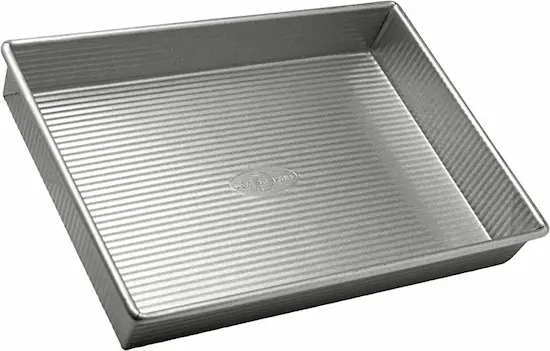
A recipe calls for a 9x13 pan. You only have an 8x8.
Or the opposite: the recipe uses two 8-inch rounds, and you want to bake it in one rectangular pan.
The answer isn't "just use what you have and hope for the best." Pan size changes batter depth, and batter depth changes how heat moves through your bake. Get it wrong and you end up with a raw center, burnt edges, or a sunken top.
This guide explains the math, gives you the key conversions, and tells you exactly how to adjust time and temperature.
Why Pan Size Changes Everything
When you pour the same amount of batter into a larger pan, it spreads thinner. When it goes into a smaller pan, it sits deeper.
Thinner batter bakes faster. Heat reaches the center quickly. If you keep the original time, you overbake.
Deeper batter bakes slower. The center stays insulated. If you keep the original time, the middle stays raw while the edges set.
This is the entire logic behind pan conversion. Everything else follows from it.
Surface Area Is the Number That Matters
The key measurement isn't pan dimensions — it's surface area. That's what determines how thin or thick your batter layer will be.
Common Pan Surface Areas
| Pan Size | Surface Area | Closest Match |
|---|---|---|
| 8x8 square | 64 sq in | 9-inch round (63.6 sq in) ✅ |
| 9-inch round | 63.6 sq in | 8x8 square (64 sq in) ✅ |
| 9x9 square | 81 sq in | 10-inch round (78.5 sq in) |
| 9x13 rectangle | 117 sq in | Two 8x8 pans (128 sq in) |
| Two 8-inch rounds | 100.5 sq in | 10x10 square (100 sq in) |
| Two 9-inch rounds | 127 sq in | 9x13 rectangle (117 sq in) |
| 8x4 loaf pan | 32 sq in | Half of an 8x8 |
| 9x5 loaf pan | 45 sq in | 7-inch round (38.5 sq in) |
💡 The formula: For rectangles and squares, surface area = length × width. For round pans, surface area = π × radius² (radius = diameter ÷ 2). A 9-inch round has radius 4.5, so: 3.14159 × 4.5² = 63.6 sq in.

The Most Common Conversions
8x8 → 9x13 (the most searched conversion)
Surface area change: 64 → 117 sq in (+83%)
Same batter in a 9x13 spreads to roughly half the depth of an 8x8. This bakes significantly faster.
Adjustment:
- Batter quantity: same
- Temperature: same
- Time: reduce by 20-25%, check early
If original recipe says 35 minutes in an 8x8, start checking at 25-27 minutes in a 9x13.
9x13 → 8x8 (scaling down)
Surface area change: 117 → 64 sq in (-45%)
Batter goes from shallow to deep. The center takes much longer to set.
Adjustment:
- Batter quantity: use 55% of the recipe (or make the full recipe and bake in batches)
- Temperature: reduce by 25°F (to prevent edges overbaking before center sets)
- Time: increase by 25-35%
Two 8-inch rounds → 9x13
Surface area change: 100.5 → 117 sq in (+16%)
Close match. Batter will be slightly shallower in the 9x13.
Adjustment:
- Batter quantity: same
- Temperature: same
- Time: reduce by 5-10 minutes, check early
8x8 → 9-inch round
Surface area change: 64 → 63.6 sq in (essentially identical)
This is the cleanest swap in baking. Nearly identical surface area means nearly identical batter depth.
Adjustment: None needed. Same temperature, same time. Check doneness at the same point.
9x13 → Two 9-inch rounds
Surface area change: 117 → 127 sq in (+9%)
Very close. Slight increase in surface area means batter will be marginally shallower.
Adjustment:
- Batter quantity: same
- Time: check 3-5 minutes early
This is the standard layer cake conversion — a sheet cake recipe into two round layers.
Loaf pan → 8x8 (or vice versa)
Surface area change: 32-45 → 64 sq in
Loaf pans are deep and narrow, creating very different heat dynamics than square pans. Dense batters (banana bread, pound cake) rely on the loaf pan's depth to cook through slowly without burning.
This conversion is the riskiest. A batter designed for a loaf pan baked in an 8x8 will often be too shallow, cook too fast, and dry out.
If you must convert: reduce temperature by 25°F and reduce time by 20-30%. Watch closely.
Pan size not in this table?
The calculator handles any combination — including odd sizes like heart pans, bundt pans, and springform pans.
How to Adjust Baking Time: The Practical Method
Time calculations are estimates. The toothpick test is truth.
The rule:
- Moving to a larger pan (shallower batter): start checking 15-20% earlier than original time
- Moving to a smaller pan (deeper batter): add 20-30% to original time, then check
Temperature adjustments:
- For significantly deeper batter (more than 50% deeper): drop temperature by 25°F so edges don't overbake before center sets
- For same-depth conversions: keep temperature identical
The toothpick test: Insert a toothpick into the center. For cakes: it should come out clean or with a few moist crumbs — not wet batter. For brownies: slightly underdone center is usually intentional.
⚠️ Don't rely on color alone. The top of a cake can look perfectly golden while the center is still raw. Always use the toothpick test when converting pan sizes — visual cues that work for the original pan don't transfer to a new shape.
Adjusting Batter Quantity for Different Pan Sizes
Sometimes you don't want to bake extra — you want to scale the recipe to fit the pan you have.
The formula:
Scale factor = Target pan area ÷ Original pan area
Example: Converting a recipe from 9x13 (117 sq in) to 8x8 (64 sq in):
Scale factor = 64 ÷ 117 = 0.55
Multiply every ingredient by 0.55. A recipe calling for 2 cups flour becomes 1.1 cups. 3 eggs becomes 1.65 eggs — round to 2 and accept slightly more moisture, or use 1 whole egg + 1 yolk.
Egg rounding is the hardest part of scaling. When the math gives you a fractional egg:
- Round down if the recipe is forgiving (brownies, bars)
- Use the fraction with yolks if precision matters (chiffon, soufflé)
- Add a tablespoon of milk or water per missing egg white to compensate for moisture
Baking Time Reference Table
These are starting points. Always check early and use the toothpick test.
| Original pan | New pan | Time adjustment | Temp adjustment |
|---|---|---|---|
| 8x8 | 9x13 | -20 to -25% | No change |
| 9x13 | 8x8 | +25 to +35% | -25°F |
| 8x8 | 9-inch round | No change | No change |
| Two 9-inch rounds | 9x13 | -5 to -10 min | No change |
| 9x13 | Two 9-inch rounds | -5 min | No change |
| 9x5 loaf | 8x8 | -20 to -30% | -25°F |
| 8x8 | 9x5 loaf | +30 to +40% | -25°F |
What Doesn't Change When You Switch Pans
Some things are fixed regardless of pan size:
Temperature stays the same for most conversions (adjust only when batter depth changes dramatically).
Ingredient ratios stay the same — you're scaling the whole recipe, not changing leavening separately.
Doneness indicators stay the same — toothpick clean, edges pulling away from the pan, internal temperature targets don't change.
What changes: time, and sometimes quantity.
The Bottom Line
Pan conversion is surface area math, not guesswork. Calculate the ratio between your original and target pan, adjust time proportionally, and use the toothpick test to confirm.
The 8x8 and 9-inch round are interchangeable. The 9x13 and two 9-inch rounds are close enough. Loaf pans are the most different and require the most care.
Related Reading
- How Pan Size Affects Baking Time — The heat distribution science behind why depth matters
- Free Cake Pan Size Converter — Any pan combination, calculated instantly
- Rice Water Ratio Chart — The same precision-over-guesswork approach, applied to rice