
Suzanne Williamson, RD
Registered dietitian and founder of Frugal Organic Mama. I've roasted turkeys for family Thanksgivings, community dinners, and once — memorably — for 40 people in an unfamiliar kitchen with one oven and four hours to spare.
🦃 Don't let a frozen turkey ruin Thanksgiving.
Enter your turkey's weight — get the exact thaw start date for refrigerator, cold water, or same-day thawing.
The year I cooked Thanksgiving for 22 people, I had everything planned except one thing: I pulled the turkey out of the oven when the timer said it was done, set it on the counter to rest, and then watched as my sister-in-law (who was trying to help) picked it up and immediately started carving.
The juices ran everywhere. The breast meat was fine. The thigh was fine. But that turkey had been resting for approximately 90 seconds before the knife went in, and I spent the next 20 minutes explaining to my father-in-law why his serving looked like it had been squeezed dry.
Turkey is not technically difficult. The variables are known. The mistakes are predictable. This guide is about understanding those variables well enough that you make the decisions consciously, rather than discovering why they matter after the fact.
The Fundamental Problem With Roasting Turkey
Turkey has a structural problem that no recipe can fully solve, only manage: the breast and thigh have different cooking requirements, and they're attached to each other.
The breast is dense white muscle that dries out above 165°F. The thigh is dark muscle with more fat and connective tissue — it benefits from longer cooking and actually improves in texture at 175–180°F. In a whole bird, the breast finishes cooking 20–40 minutes before the thigh reaches safe temperature.
Every roasting method is essentially a different answer to the question: how do we get the thigh to 165°F+ without drying out the breast?
Understanding this framing helps you evaluate techniques. Dry brining helps by pre-hydrating the meat. Spatchcocking works because it flattens the bird so the thick thigh is exposed to more direct heat. Starting at high heat then reducing works because it jumpstarts browning before the long low-heat phase. Tenting the breast works by slowing the breast's cooking once it's approaching done.
I'll walk through each technique with my honest experience of what's worth the effort and what isn't.
Before Roasting: Thawing (The Step People Underestimate)
The most common Thanksgiving crisis I've seen isn't a cooking problem — it's a still-frozen turkey at 8am on Thursday.
A whole frozen turkey thaws slowly because of its dense mass. The outside thaws first while the center stays frozen. If you try to speed this by leaving it at room temperature, the exterior enters the bacterial danger zone (40–140°F) while the interior is still frozen solid.
Refrigerator thawing (safest, requires planning): Allow 24 hours of thawing time for every 4–5 pounds of turkey.
| Turkey Weight | Fridge Thaw Time | Start Thawing (for Thursday) |
|---|---|---|
| 8–12 lbs | 2–3 days | Monday or Tuesday |
| 12–16 lbs | 3–4 days | Sunday or Monday |
| 16–20 lbs | 4–5 days | Saturday or Sunday |
| 20–24 lbs | 5–6 days | Friday or Saturday |
The Turkey Defrost Calculator gives you the exact start date for your bird's weight.
Cold water thawing (faster, more hands-on): 30 minutes per pound in cold water, changing the water every 30 minutes. A 15-pound turkey takes about 7–8 hours. Keep the turkey in its original packaging submerged in a sink or bucket. Cook immediately after thawing — don't return it to the refrigerator.
I've done cold water thawing many times when planning slipped. It works, but it requires actually being home to change the water, and you need to have your oven ready to go when the bird comes out of the water.
Same-day option (microwave): Possible for small turkeys that fit in your microwave, but I don't recommend it. Uneven thawing means some parts begin cooking while others are still icy, and the texture is noticeably different. Use the cold water method instead.
Dry Brining: Worth Doing, Easy to Skip
I started dry brining about six years ago and I won't go back. The technique is simple: rub the turkey all over (including under the breast skin if possible) with kosher salt, about ½ teaspoon per pound, and refrigerate uncovered for 24–72 hours.
What this does: salt initially draws moisture out of the turkey (you'll see liquid pooling in the pan after 12 hours), then the moisture reabsorbs along with the dissolved salt, seasoning the meat all the way through and altering the protein structure in a way that helps the meat retain juice during cooking.
The longer you can brine, the better — 48 hours is noticeably better than 24. I've gone to 72 hours and found no degradation in quality.
The other benefit of dry brining that people don't always mention: the skin dries out in the refrigerator, and dry skin browns dramatically better. My best-looking turkeys have all been dry brined.
If you can't brine: Pat the turkey completely dry with paper towels before seasoning. Moisture on the skin steams rather than browns. Dry is the minimum; brined is better.
Roasting Temperatures: The High-Low Method
I've settled on a consistent approach after testing variations:
450°F for the first 30–45 minutes (or 425°F if your oven runs hot): high heat browns the skin fast before the meat heats through significantly.
325°F for the remainder of cooking time: low and slow gets the thigh to temperature without overcooking the breast.
This is not the only approach — some people do 350°F the whole way, some do 275°F all the way through. What I've found: the jump-start at high heat produces noticeably better skin color, and 325°F is forgiving enough that the bird doesn't race ahead of my attention.
Roasting Time by Weight
These are estimates at 325°F after the initial high-heat period, for an unstuffed turkey. Always verify with a thermometer — these times vary based on your oven, your roasting pan, whether the turkey came from the refrigerator or room temperature, and how often you open the oven.
| Turkey Weight | Estimated Total Time | Start checking temp at |
|---|---|---|
| 8–12 lbs | 2¾ – 3 hours | 2 hours 15 min |
| 12–14 lbs | 3 – 3¾ hours | 2 hours 30 min |
| 14–18 lbs | 3¾ – 4¼ hours | 3 hours |
| 18–20 lbs | 4¼ – 4½ hours | 3 hours 30 min |
| 20–24 lbs | 4½ – 5 hours | 3 hours 45 min |
⚠️ Stuffed turkey time warning: A stuffed turkey takes significantly longer because the stuffing adds thermal mass. The stuffing center must also reach 165°F — which typically means the breast is overcooked. If you want stuffing cooked inside the bird for tradition's sake, bake the stuffing separately in a covered dish and stuff the cavity loosely just before serving for presentation.
Thermometer Placement: The One Thing That Matters Most
Every turkey failure I've witnessed that wasn't a thawing problem was a thermometer problem.
Where to measure: The thickest part of the thigh, not touching the bone. Insert the thermometer horizontally into the thigh from the side, going toward the center of the mass. The tip should be in muscle, not against the bone (which conducts heat and reads higher) and not near the surface (which reads the external temperature, not the internal).
Why not the breast: The breast consistently reaches safe temperature before the thigh. A breast reading of 165°F tells you the breast is safe and almost certainly means the thigh is not yet safe. Measuring the breast gives you no useful information for determining doneness.
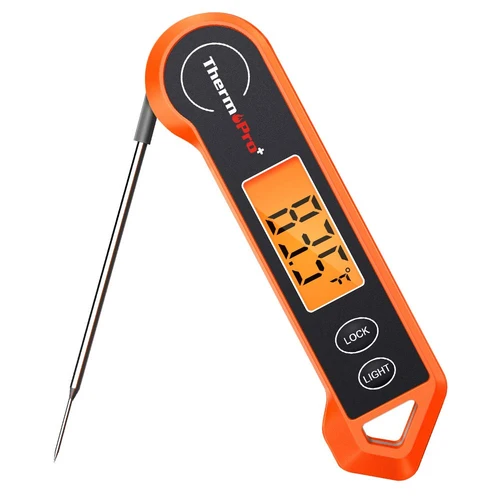
The thermometer I use: An instant-read digital thermometer. I've tried the pop-up buttons that come in grocery store turkeys — they're notoriously inaccurate, set to 180°F+ rather than 165°F, and I don't trust them. A $12 digital instant-read from any kitchen store is the most useful thing you can bring to a turkey.
The secondary check: After the thigh reads 165°F, pierce the thigh deeply with a knife or skewer and observe the juices. They should run clear, not pink. Clear with 165°F thermometer reading = done. Any pink = more time, regardless of what the thermometer said (which usually means you missed the right spot with the thermometer).
Managing the Breast-Thigh Temperature Gap
Here's the honest reality: on a whole bird at standard roasting temperature, the breast will often be 175–180°F by the time the thigh reaches 165°F. That's overcooked breast by most standards.
These techniques reduce the gap:
Option 1: Tent the breast with foil. When your breast reads 155°F (or about 45 minutes before your estimated done time), lay a loose tent of aluminum foil over the breast only. This slows the breast's heat absorption while the thigh continues to cook. I use this more often than any other technique because it requires no special preparation.
The sensory cue: the breast skin stops actively browning under the foil but stays crisp from the high-heat start. Remove the foil for the last 20 minutes to recrisp.
Option 2: Start breast-side down. Roast the turkey breast-side down for the first 45–60 minutes. The thighs, now on top, get more direct heat. Flip breast-side up for the remainder. The downside: flipping a hot turkey is genuinely awkward and you need two pairs of oven mitts and a helper. I did this for several years and found the improvement real but the logistics annoying. I now prefer the foil method.
Option 3: Spatchcock. Remove the backbone entirely, flatten the bird. Now the thigh is next to the breast at the same distance from the heat source, which reduces the temperature gap dramatically. Cooking time drops significantly — a 14-pound spatchcocked turkey can be done in 75–90 minutes at 425°F.
The tradeoff: presentation. A spatchcocked turkey does not look like a Thanksgiving postcard. For a family that cares about the carving ceremony, it's wrong. For a family that cares about the food, it's the best way to cook a turkey.
Option 4: Two-temperature probe. Leave a probe thermometer in the thigh throughout cooking, with the alarm set for 165°F. Cook entirely at 325°F and remove when the alarm sounds. Add a separate probe in the breast and watch both. When the breast hits 150°F, tent it. Simple and accurate if you have two probes.
The Rest Period
This is where the Thanksgiving I described earlier went wrong.
When turkey (or any roast) is in the oven, the muscle fibers contract from heat and squeeze moisture toward the center of the meat. When you remove it from the oven, those fibers gradually relax and the moisture redistributes. Cut immediately and the moisture floods out onto your cutting board and is gone. Rest it for 30–45 minutes and the moisture stays in the meat.
The turkey won't get cold. A 15-pound bird holds heat for well over an hour — the internal temperature actually continues to rise 5–10 degrees after you remove it from the oven (carryover cooking). The rest period gives the center of the thigh a chance to get the benefit of this carryover heat while the exterior cools to a safe carving temperature.
What I do: remove from the oven, tent loosely with foil (don't seal it — you'll trap steam and soften the skin), and set a timer for 30 minutes minimum. 45 minutes for birds over 14 pounds. In practice, Thanksgiving logistics almost always create a rest period anyway — the oven is needed for something else, or everyone is gathering, or someone is finishing a side dish. The turkey being "done" 30 minutes before you serve it is a feature, not a problem.
The feel of rested vs. non-rested: when you insert the knife for the first cut, a well-rested turkey offers slight resistance and the juices bead at the cut surface. An unrested turkey floods. You can feel the difference before you see it.
Still need to thaw your turkey?
Enter your weight — the calculator gives you the exact start date and time for safe refrigerator or cold water thawing.
Buying a Turkey: What I've Learned
Fresh vs. frozen: Fresh turkeys are genuinely better — more consistent moisture, better texture. They're also 50–100% more expensive and require advance ordering from a butcher or farm. For most families, a frozen turkey from the grocery store is fine, and the quality gap shrinks if you dry brine.
Size guidance: 1–1.5 pounds per person for a bone-in whole turkey. More if you want significant leftovers. A 15-pound turkey serves 10–12 people with leftovers.
Organic vs. conventional: As an RD, I'll say this: the quality difference in a pastured or organic turkey is real and noticeable — better flavor, firmer texture, less water-logged. The price difference is also real ($50–$80 for a 12-pound heritage breed vs. $15–$25 for a conventional one). This is an individual decision. What I don't compromise on is the size — I buy the right size bird rather than going large on a cheap one.
Self-basting birds: These are injected with a saline solution and sometimes butter or oil. They're marketed as more moist, but the injection contains significant sodium and the flavor can be one-dimensional. I prefer to manage the moisture myself through brining and technique. If you're buying a self-basting bird, skip the dry brine — it's already heavily salted.
Heritage breeds: Narrower breast, stronger flavor, better suited to dry heat cooking. If you've only ever had a commercial Broad-Breasted White, a heritage breed tastes different enough to be surprising. Cooking times will be shorter because they're smaller and leaner.
The Food Safety Math
As an RD, I want to be clear about the actual risk: turkey is one of the most common sources of foodborne illness outbreaks in the US, with most incidents tied to improper thawing, undercooking, and inadequate storage of leftovers.
Thawing: Never at room temperature. Refrigerator or cold water only.
Cross-contamination: Raw turkey juices should not contact any surface, utensil, or food that won't be cooked. Wash your hands after handling raw turkey. Use a dedicated cutting board.
Stuffing: If cooking stuffing inside the bird, the stuffing center must reach 165°F. In practice this means the breast will be overcooked. Cook stuffing separately.
Leftovers: Refrigerate within 2 hours of serving. Turkey is safe in the refrigerator for 3–4 days. Freeze anything beyond that. Reheat to 165°F. Get our full leftover turkey recipe guide and 7-day plan →
The turkey carcass: One of the most valuable things in the kitchen after Thanksgiving. A turkey stock made from the carcass, neck, and giblets is the foundation of serious cooking for weeks. Cover with cold water, simmer 3–4 hours with aromatics, strain, cool, and freeze in quart containers. You will use it.
What Goes Wrong and Why
Problem: Skin is pale and flabby Cause: moisture on the skin, or insufficient high-heat time Fix: Pat completely dry before seasoning. Start at 450°F for 30–45 minutes. Don't cover the bird at the start.
Problem: Breast is dry despite correct thigh temperature Cause: the breast finished cooking significantly before the thigh Fix: Use the foil tent technique when breast reaches 155°F. Dry brine next time.
Problem: Undercooked thigh despite long cooking time Cause: thermometer in the wrong spot, thermometer inaccurate, or turkey was still partially frozen Fix: Verify thermometer accuracy in boiling water (should read 212°F). Make sure turkey was fully thawed. Re-insert thermometer in the correct position.
Problem: Turkey done 90 minutes early Cause: bird was smaller than expected, oven runs hot, or the bird was at room temperature when it went in Fix: Hold in a 170°F oven, tented with foil. It will stay safe and reasonably moist for up to 90 minutes. This is not ideal but it happens, and it's recoverable.
Problem: Pan juices burned black Cause: drippings in the pan concentrated and burned from the high oven heat Fix: Add 1 cup of water or chicken stock to the roasting pan before it goes in the oven. Check at the high-heat stage and add more if needed. The drippings should be golden brown, not black.
Related Reading
- How Long to Thaw a Turkey in the Refrigerator — Exact timelines by weight for all thawing methods
- Food Safety Danger Zone Guide — The temperature range where bacteria multiply and how to stay out of it
- Best Way to Defrost Meat — Safe thawing methods for all proteins
- Countertop vs Fridge vs Water vs Microwave Defrosting — Comparison of all thawing methods with safety and time tradeoffs