
Suzanne Williamson, RD
Registered dietitian and founder of Frugal Organic Mama. I grow broccoli in our zone 6b garden every year — and I have ruined more than my share of it by treating it like green beans. Broccoli's florets and stems cook at completely different rates, and the single-number guides you find everywhere are wrong for one of them. This guide is the method I wish I had ten years ago.
🥦 Need exact timing for your batch?
The blanching timer covers broccoli florets and stems plus 25+ other vegetables — with ice bath alerts and altitude adjustments built in.
Why Broccoli Is a Blanching Challenge (Not Like Green Beans)
If you have blanched green beans before, you might think you have this whole blanching thing figured out. Pop the beans in boiling water for three minutes, ice bath, done. Easy.
Then you try broccoli — and suddenly you are staring at a bowl of sad, yellow-green mush with florets falling apart like wet confetti.
Broccoli is different. The reason is hiding in plain sight: a single head of broccoli contains two completely different structures. The florets are a dense cluster of unopened flower buds — thin-skinned, tightly packed, with tiny crevices that trap heat. The stem is a thick, fibrous stalk built like a tree branch. The same cooking time cannot possibly work for both.
And yet most guides give you one number. That single number is why most home-cooked broccoli is either underdone (raw, tough stems) or overdone (mushy, yellow florets).
Green bean blanching rules simply do not apply here. Green beans are uniform cylinders; broccoli is architectural. Treat it like the complex vegetable it is, and you will get bright green, crisp-tender results every time.
Broccoli Blanching Times at a Glance (Quick-Reference Table)
| Cut | Boil Time | Steam Time | Ice Bath |
|---|---|---|---|
| Florets (1-inch) | 3 min | 5 min | 3 min |
| Stems (peeled, 1-inch) | 4 min | 4.5 min | 3 min |
| Whole head (small, 5–6 oz) | Not recommended | 5–6 min | 5 min |
Bookmark this table. Print it out. Stick it on your fridge. These numbers are the difference between broccoli you want to eat and broccoli you throw away.
If you live above 3000 feet, add 1 minute to all blanching times — water boils at a lower temperature at elevation, which means enzymatic deactivation takes longer.

Why Broccoli Turns Yellow (And How Blanching Prevents It)
Here is the short chemistry lesson — I promise it is worth your time because it explains the single most common broccoli failure.
Broccoli gets its bright green color from chlorophyll. When you apply heat, two things happen. First, the heat breaks down the cell walls, which releases natural acids inside the broccoli. Second, those acids react with the chlorophyll molecules and yank out the magnesium atom at their center. The result is a compound called pheophytin — and pheophytin is olive-drab or yellow, not green.
This reaction speeds up dramatically above 80°C (176°F). And since boiling water sits at 100°C, you are working in the danger zone from the moment the broccoli hits the pot.
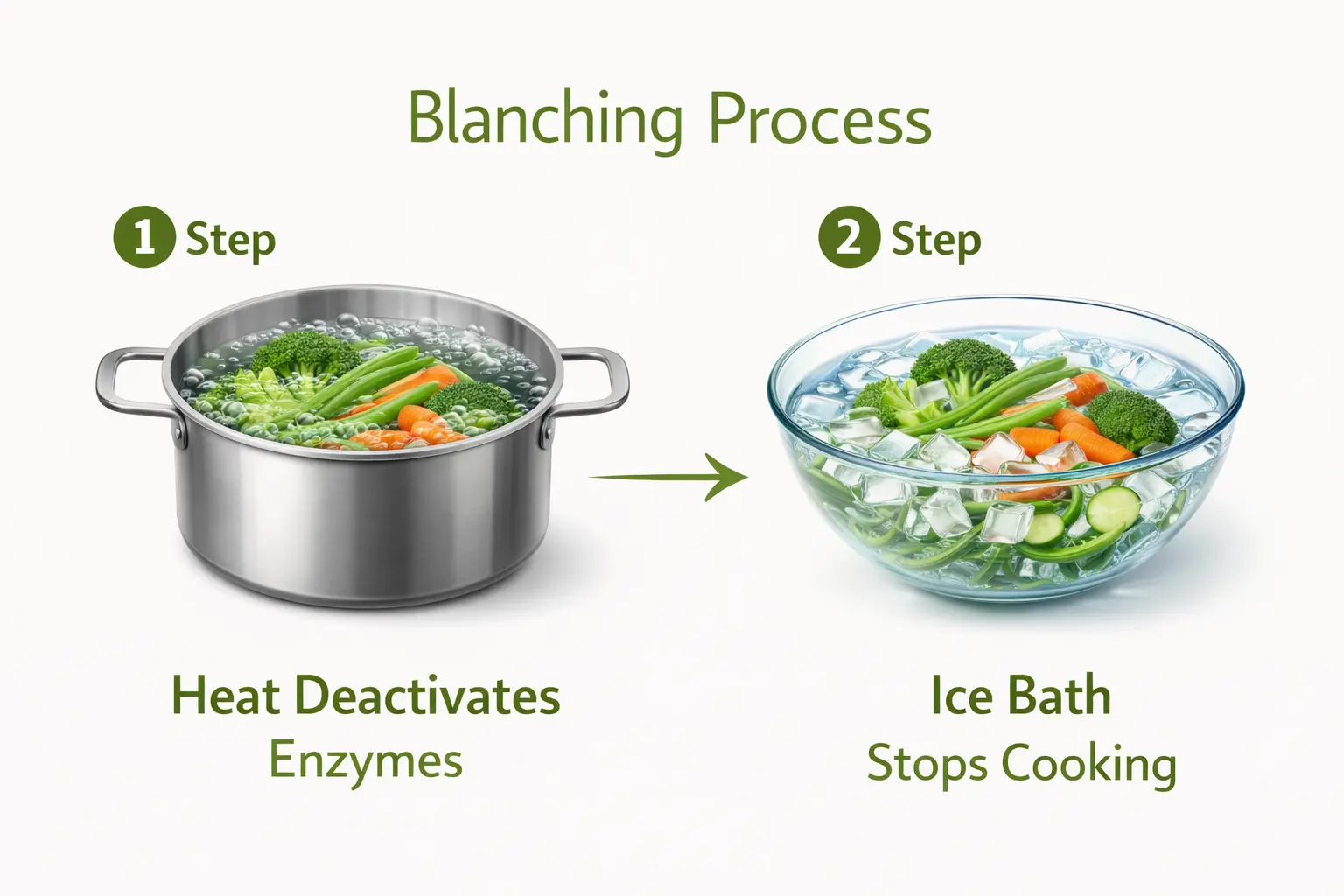
The solution is speed. A quick blanch — 3 minutes for florets, 4 minutes for stems — followed by an immediate ice bath at or below 4°C (40°F). The cold stops the pigment-degrading reaction within about 30 seconds, locking in that bright green color.
There is another wrinkle specific to broccoli: the residual cooking effect. Dense floret clusters hold onto heat for a surprising 60 to 90 seconds after you pull them out of the water. That means even if you hit the perfect boil time, you can still end up with overcooked florets if you dawdle getting them into the ice bath. Have your ice water ready before you drop the first piece of broccoli. No exceptions.
Step-by-Step: How to Blanch Broccoli Florets
Let us walk through the floret protocol, which is the most common way to blanch broccoli.
Prep. Start with one head of broccoli. Cut the florets away from the central stem, aiming for uniform pieces about one inch across. Uniformity matters — a 2-inch floret takes longer to cook than a half-inch piece, and you cannot fix that mid-blanch. Rinse the florets in cold water and drain.
Boil method. Fill a large pot with water — at least four quarts for a standard batch. Add one tablespoon of salt per quart; salted water seasons the broccoli and helps it hold its color. Bring it to a full rolling boil. Drop the florets in and set a timer for 3 minutes exactly. Do not cover the pot; you want to watch the color change.
Steam method. If you prefer steaming (less nutrient loss, gentler on delicate florets), bring the water to a full boil in a pot fitted with a steamer basket. Spread the florets in a single layer, cover, and steam for 5 minutes.
The ice bath. While the broccoli cooks, prepare a large bowl of ice and cold water. The water should be at or below 4°C (40°F) — a thermometer helps, but plenty of ice and minimal water is a good rule of thumb. The moment the timer goes off, use a slotted spoon or strainer to transfer the florets directly into the ice bath. Agitate them gently so cold water reaches every crevice. Leave them for 3 full minutes.
Drain and dry. Lift the florets out of the ice bath and transfer to a clean kitchen towel or a salad spinner. Getting them fully dry is critical if you plan to freeze them — excess moisture turns to ice crystals and causes freezer burn. Pat gently or spin until no water drips.
How to Blanch Broccoli Stems (Don't Waste Them!)
The stem — sometimes called the stalk — is perfectly edible and honestly, delicious. It just needs different treatment than the florets.
Prep. Cut off the woody bottom quarter-inch of the stem. Use a vegetable peeler or a paring knife to remove the tough outer layer. You want to see the pale green, tender interior underneath. Cut the peeled stem into one-inch pieces or half-inch slices, depending on what you plan to use them for.
Timing. Stems need one extra minute compared to florets because their cell walls are thicker and denser. Boil for 4 minutes, steam for 4.5 minutes. Ice bath for 3 minutes.
Practical tip. If you are doing a whole head at once, start the stems first. Drop the stem pieces into the boiling water, wait one minute, then add the florets. Everything finishes at the same time.
What to do with blanched stems. They are fantastic in stir-fries, blended into soup bases, or shredded into a broccoli slaw. Their texture after blanching is tender but still firm — not mushy like florets can get. Some people actually prefer the stems.

How to Blanch Whole Broccoli (And When to Bother)
Blanching a whole head of broccoli is not for everyday cooking. It is useful when you are meal-prepping a large batch for freezing and want to save prep time, or when you are serving whole roasted broccoli later.
Only try this with small to medium heads — about 5 to 6 ounces each. Anything larger will cook unevenly.
Method: steam only. Do not boil a whole head. The outer florets will overcook and disintegrate before the center of the stem is done. Steam for 5 to 6 minutes, then plunge into an ice bath for 5 minutes. Check doneness by piercing the stem with a knife — it should slide in with moderate resistance.
Freezing Blanched Broccoli for Long-Term Storage
Blanching before freezing is non-negotiable. Raw broccoli held at freezer temperature slowly turns brown, develops off-flavors, and loses nutritional value. The blanching step deactivates the enzymes that cause these problems.

Step 1: Flash-freeze. Spread the blanched, dried florets and stems in a single layer on a parchment-lined baking sheet. Do not let pieces touch. Freeze for 1 to 2 hours until each piece is individually frozen.
Step 2: Package. Transfer the frozen pieces into vacuum-seal bags or heavy-duty freezer bags. Remove as much air as possible — a straw works if you do not have a vacuum sealer. Air is the enemy of frozen vegetables.
Step 3: Label. Write the date, the cut (florets or stems), and the blanch method on the bag. Trust me, six months from now you will not remember.
Shelf life. Blanched broccoli keeps for 8 to 12 months at a steady -18°C (0°F). Beyond that it is still safe to eat but the quality declines.
Using frozen broccoli. Cook from frozen. Add it directly to soups, stir-fries, casseroles, or pasta dishes. Do not thaw and do not re-blanch — it is already cooked and you will turn it to mush.
One more thing: expect about a 15 to 20 percent volume reduction after blanching. Broccoli shrinks as the cell structure softens and trapped air escapes. Plan your batch sizes accordingly.
Common Mistakes (And How to Fix Them)
Mushy florets. You over-blanched. Cut your time by 30 seconds next batch. Remember the residual cooking effect — pull the florets out a few seconds early if you are slow getting to the ice bath.
Yellow or olive-drab color. Your ice bath was either not cold enough or not fast enough. Verify the water is at or below 4°C (40°F) before you start cooking. Transfer the broccoli immediately — no rinsing, no shaking off excess water, straight into the cold.
Bland taste. Salt your blanching water. One tablespoon per quart makes a noticeable difference. Broccoli absorbs a bit of salt during blanching, which seasons it from the inside out.
Freezer burn. Your broccoli was not dry enough before freezing, or there was too much air in the package. Pat or spin dry thoroughly and remove all air.
Uneven cooking. Your pieces were not uniform in size. Take the extra five minutes to cut florets and stems to consistent dimensions.
Blanched Broccoli vs Raw: When to Use Each
| Use Case | Best Choice | Why |
|---|---|---|
| Crudité platter with dip | Raw | Crisp texture, better crunch |
| Garden salad | Raw (if very fresh) | Keeps its bite |
| Stir-fry | Blanched | Already tender, quick finish |
| Casserole or pasta bake | Blanched | Holds shape, won't get watery |
| Soup or blended dish | Blanched | Smooth texture, no raw bitterness |
| Freezer storage | Blanched | Essential — raw does not freeze well |
Blanched broccoli has a tender-but-not-soft texture and a sweeter, milder flavor than raw. Raw broccoli is sharper, almost pungent, with a firm crunch. Both have their place. The trick is knowing which job each one is suited for.
Related Reading
- How to Blanch Mushrooms — The exception to every blanching rule: steam only, lemon pretreatment
- How to Blanch Green Beans — The vegetable everyone compares broccoli to
- How to Blanch Carrots — Dense root vegetable with ¼-inch vs ½-inch timing differences
- How to Blanch Vegetables for Freezing — Universal method covering all vegetables
- Why Blanching Prevents Freezer Burn — The enzyme science behind every blanch
- Blanching Hub — All blanching guides, tool access, and vegetable-specific times in one place