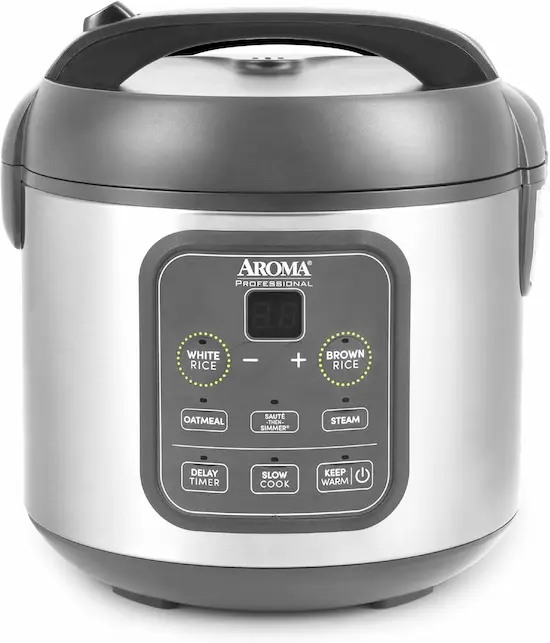
🍚 Get the exact water ratio for your Aroma in 10 seconds.
Select Aroma, choose your rice type, enter cups — get the precise amount with no guesswork.
Most people think their Aroma rice cooker is broken when rice turns mushy, dry, or burnt. It almost never is.
The real problem is simple: the measuring cup included with your Aroma is not a standard US cup. That small difference quietly ruins water ratios, cooking times, and texture for thousands of people every day.
Once you understand how Aroma designed their system, cooking perfect rice becomes nearly automatic.

The Aroma Cup Mystery: 180ml vs Standard US Cup (This Is Why You're Failing)
Every Aroma cooker includes a plastic measuring cup. Most users ignore it or replace it with a kitchen measuring cup. That's mistake number one.
| Cup Type | Volume |
|---|---|
| Aroma rice cup | 180 ml |
| Standard US cup | 240 ml |
1 Aroma cup = 0.75 of a normal cup.
If you use a standard measuring cup but follow Aroma instructions, you accidentally add 33% too much rice. The cooker then lacks enough water. Result: hard centers, uneven cooking, burnt bottom layer.
Why Aroma uses a smaller cup: Rice cookers originated in Japan, where rice measurements traditionally use the gō unit (~180ml). Aroma kept this standard so water lines match internal heating sensors, cooking cycles stay predictable, and evaporation calculations remain accurate. Your cooker is calibrated around this exact volume.
The golden rule: Always match rice cups to numbered water lines — not external measuring guides. If you add 3 cups of rice, fill water to Line 3 inside the pot.
Aroma Rice Cooker Water Ratios (Standard Cup Version)
Some users lose the original cup or prefer working in standard measurements. In that case, use measured water instead of guessing from the line marks.
| Rice Type | Standard-Cup Ratio | Aroma Rule of Thumb | Typical Cook Time |
|---|---|---|---|
| White rice / jasmine | 1:1.33 | If using the original Aroma cup, fill water to the matching line inside the pot. | 15–20 min |
| Basmati | 1:1.33 | If using the original Aroma cup, fill water to the matching line inside the pot. | 15–22 min |
| Sushi / short grain | 1:1.2 | Match the line carefully; short grain punishes overfilling fast | 18–25 min |
| Brown rice | 1:1.75 | Use Brown Rice setting or water slightly above the matching line | 35–50 min |

How to Read the Water Lines Inside Your Aroma Pot
Those lines inside the pot confuse almost everyone. They are not water measurements. They represent rice quantity markers.
When you see markings labeled "WHITE RICE — 1 2 3 4," it means: add rice using the Aroma cup, then fill water to the matching number. Add 2 cups of rice, fill water to line "2."
The cooker's thermostat detects moisture evaporation and switches automatically from Cook to Warm when water disappears. That's why exact water alignment matters.
Why measuring water separately causes problems: Many blogs suggest measuring water independently. This breaks Aroma's calibration because evaporation rate changes, the heating sensor misreads moisture, and the automatic shutoff triggers too early or too late. Trust the internal system.

White Rice Settings vs Brown Rice Settings
Aroma cookers adjust cooking automatically based on heat duration. The settings mainly change time and temperature curve.
White Rice Mode works best for jasmine, basmati, sushi, and long grain white rice. It uses rapid heating, a boil phase, steam absorption, and auto-switch to Warm.
Brown Rice Mode is necessary for brown rice because it requires longer hydration, slower heat ramp, and extended steaming. Skipping this mode causes crunchy centers.
| Setting | Heat Intensity | Duration |
|---|---|---|
| White Rice | Higher early heat | Short |
| Brown Rice | Gradual heat | Long |

How to Reheat Rice in Your Aroma (The 1 Tbsp Method)
Leftover rice dries because moisture evaporates during refrigeration. Reheating without adding water makes rice hard and unpleasant.
The 1 Tablespoon Method: For each cup of cooked rice, add 1 tablespoon water, break up rice gently, close the lid, and press Cook. The cooker re-steams the rice. Within 3–5 minutes, it switches to Warm automatically.
Result: fluffy texture restored, no microwave dryness, zero waste. Rice grains rehydrate through steam, not direct heat. The cooker recreates original cooking conditions on a smaller scale.
I Lost My Aroma Cup — What Now?
You don't need to replace it.
| Aroma Cups | Standard Cups |
|---|---|
| 1 | 0.75 cup |
| 2 | 1.5 cups |
| 3 | 2.25 cups |
Or simpler: fill rice to desired level visually, then match water to the corresponding line. The lines matter more than cup size.
Common Aroma Rice Cooker Problems and Fixes
Rice Too Mushy: Cause is too much water or skipped rinsing. Fix by rinsing rice until water runs clear and reducing water slightly next time.
Rice Too Dry: Usually caused by accidentally using a standard cup instead of the Aroma cup, or opening the lid during cooking. Keep lid closed and use correct ratios.
Burned Bottom Layer: Usually not burning — just caramelized starch. Excessive browning means insufficient water, damaged nonstick coating, or cooking too small a batch. Cook at least 1 cup minimum.
Cooker Switches to Warm Too Fast: Likely causes are wrong water line, extremely small batch, or high altitude evaporation. Add 1–2 tablespoons extra water.

Frugal Tip: Buy Rice in Bulk and Portion Correctly
Rice is one of the cheapest pantry staples when bought in large bags. A 20-lb bag often costs 30–50% less per pound than small packages.
To avoid waste: portion rice into 2–3 cup containers, label with cooking ratios, and store airtight. Your Aroma cooker makes bulk cooking predictable — perfect for meal prep families who want consistent results without recalculating every time.
Rice Type Adjustments Cheat Sheet
| Rice Type | Adjustment |
|---|---|
| Jasmine | Slightly less water |
| Basmati | Rinse thoroughly before cooking |
| Sushi rice | Exact line measurement critical |
| Brown rice | Extra water + Brown setting |
| Mixed grains | Add 10% more water |
Food Safety: How Long Can Rice Stay on Warm?
Aroma's Keep Warm is convenient but not unlimited.
| Time | Quality |
|---|---|
| 0–5 hrs | Excellent texture |
| 5–8 hrs | Good, slight drying |
| 8–12 hrs | Drying increases |
The 12-hour ceiling is what Aroma-class manufacturers state; the 0–5 and 5–8 hour tiers are our own kitchen-test quality gradient, not a published spec.
After 12 hours, refrigerate leftovers. For frugal meal prep, refrigerate promptly and use the 1 Tbsp reheat method rather than leaving rice on Warm overnight.
Advanced Texture Control
Small water adjustments create noticeably different results.
| Goal | Adjustment |
|---|---|
| Firmer rice | -1 tbsp water |
| Softer rice | +1 tbsp water |
| Sticky rice | Skip rinsing |
| Separate fluffy grains | Rinse well + rest 10 min |
Related Reading
- Rice Water Ratio Chart — Every rice type and cooking method in one reference, including Aroma-specific adjustments
- Rice Cooker Lines vs Measuring Cups — Why the water line markings inside your Aroma don't match standard US measuring cups
- How Long to Cook Rice in a Rice Cooker — Timing chart for all rice types across different rice cooker models
- Pressure Cooker Rice Ratios — Why Instant Pot and rice cooker ratios diverge even when the grain is the same
- Zojirushi Rice Cooker Instructions — Same cup-and-line rule applies on a Zojirushi; every menu setting decoded
- Cuckoo Rice Cooker Instructions — The same 180 ml cup on a Korean pressure cooker, plus the release sequence
- Does Rice Age Matter? — How rice freshness changes water absorption — particularly important for bulk rice in a rice cooker