
Suzanne Williamson, RD
Founder of Frugal Organic Mama. I switched to pour over about four years ago after my drip machine broke and I decided not to replace it. The learning curve was real — my first three weeks produced coffee that ranged from sour dishwater to bitter medicine. What I learned in that process is what this guide covers.
☕ What's your exact coffee and water amount?
Enter your cup size — the calculator gives you precise grams for any pour over ratio, from a single V60 cup to a full Chemex.
Pour over coffee has a reputation for being fussy. That reputation is half earned and half exaggerated.
The ratio part isn't complicated: 1 gram of coffee per 15 grams of water. The part that actually takes practice is the bloom and the pour technique — and the reason your first few attempts taste wrong usually has nothing to do with the ratio at all.
This guide covers the numbers first, then the technique details that determine whether those numbers actually work.
The Ratio: 15:1 as the Starting Point
Pour over uses a 15:1 coffee-to-water ratio by weight. This is slightly stronger than standard drip (16:1–18:1) and produces a clean, balanced cup that showcases the characteristics of the bean.
| Cup Size | Coffee (15:1) | Water | Bloom water |
|---|---|---|---|
| Small cup (200ml) | 13g | 200g | 30g |
| Standard cup (300ml) ⭐ | 20g | 300g | 40g |
| Large cup (400ml) | 27g | 400g | 55g |
| Chemex 2-cup (500ml) | 33g | 500g | 66g |
| Chemex 4-cup (800ml) | 53g | 800g | 106g |
Adjusting for taste:
- Want stronger? Use 1:14 — 21g coffee for 300g water
- Want lighter? Use 17:1 — 18g coffee for 300g water
- Tasting sour or acidic despite correct ratio? The grind is too coarse, or you skipped the bloom
- Tasting bitter or harsh? The grind is too fine, or your total brew time exceeded 3:30
I tested the same beans (a medium-roast Ethiopian natural process) at 1:13, 15:1, and 17:1 with identical grind size and technique. At 1:13 the cup was intensely fruity and slightly syrupy. At 15:1 the fruit was present but balanced with a clean finish. At 17:1 the flavors were thin and the coffee tasted more like water than coffee. The 15:1 sweet spot is well-established for a reason.
The Bloom: Why Your Ratio Doesn't Matter Without This Step
Fresh coffee releases CO₂ gas — a byproduct of the roasting process that continues off-gassing for days to weeks after roasting. This gas is why specialty coffee bags have one-way valves.
When water contacts CO₂-loaded grounds, the gas forms bubbles that create channels and resist even saturation. Water flows through the channels (where it's easy) rather than through all the grounds evenly. The result: some coffee over-extracts (bitter, harsh) while other coffee under-extracts (sour, thin) simultaneously.
The bloom pre-saturates the grounds and lets the CO₂ escape before you add the rest of the water.
How to bloom:
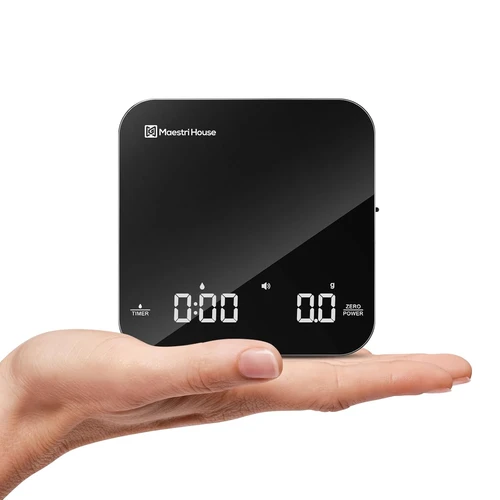
- Set your timer
- Pour 2–3 times the coffee weight in water over the grounds (40–60g for 20g coffee)
- Stir gently or swirl to ensure all grounds are wet
- Wait 30–45 seconds — you'll see the grounds swell and bubble (this is CO₂ releasing)
- Begin your main pour when the surface starts to fall
The sensory signal I watch for: during the bloom, the coffee bed rises and the surface has small bubbles forming and popping. When the surface starts dropping slightly — not dramatically, just beginning to recede — that's my cue to start pouring. Usually about 35–40 seconds with fresh beans, sometimes as little as 20–25 with very fresh beans (roasted within the last week).
💡 If your beans don't bloom much: They're probably not very fresh. Coffee roasted more than 3–4 weeks ago has already off-gassed most of its CO₂. This isn't a quality problem per se — older beans actually produce more predictable extraction — but they won't produce the dramatic dome that fresh beans do. Extend the bloom to 45–60 seconds regardless.
Grind Size: The Variable That Controls Everything Else
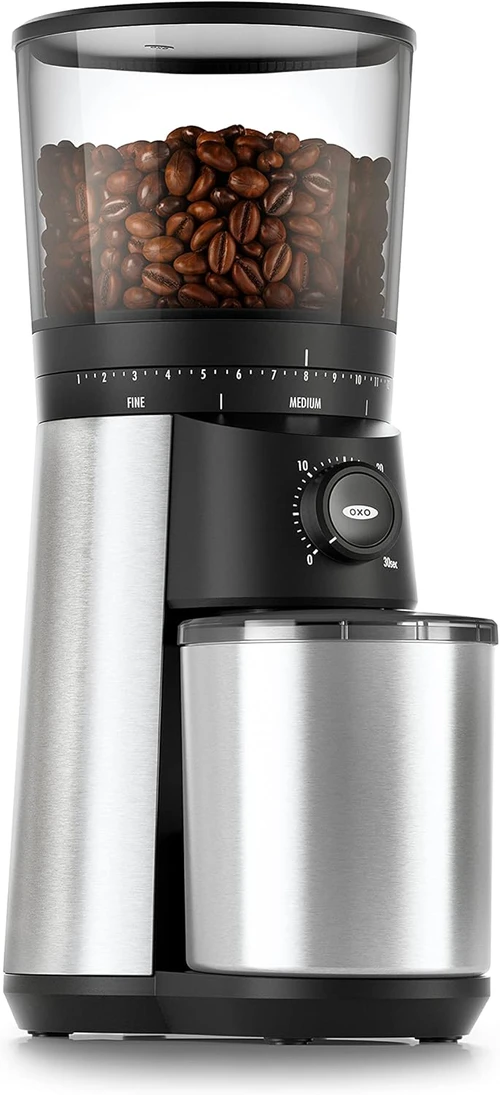
Pour over is more sensitive to grind size than almost any other brew method. A small change — one step on a burr grinder — noticeably changes the flavor.
Target: medium-coarse
Looks like coarse sand or raw sugar. Finer than French press (which looks like coarse salt), coarser than drip machine (which looks like fine sand).
The diagnostic:
- Cup tastes sour, sharp, acidic: Grind finer. The water passed through too quickly and didn't extract enough.
- Cup tastes bitter, harsh, dry: Grind coarser. The water moved too slowly and over-extracted.
- Drain time under 2 minutes: Grind finer
- Water pools on top, drain takes over 4 minutes: Grind coarser
The grind adjustment should be your first fix when something tastes wrong — before changing the ratio, the temperature, or the pour technique. Grind size has the largest single effect on flavor.
For more on extraction science, see Why Coffee Tastes Bitter or Sour.
The Pour Technique
Pour over gives you more control over extraction than any other method — because you control exactly how and when water contacts the grounds.
Basic technique (works well for V60, Chemex, Kalita Wave):
Rinse the filter with hot water before adding coffee. This removes the papery taste from the filter and preheats the vessel.
Add coffee, shake gently to level the bed. An even bed extracts more evenly.
Start timer, begin bloom pour. Use slow, circular motions from the center outward. Don't pour into the center only — wet all the grounds.
Wait 30–45 seconds for bloom.
Continue pouring in pulses. Pour slowly in concentric circles, let the level drop, pour again. The circle pattern distributes water evenly. Most people do 3–4 pours after the bloom.
Total time target: 2:30–3:30 minutes from first pour to last drip.
The feel I've developed: when pouring goes right, there's a rhythm to it — pour, wait, pour, wait. The coffee bed stays consistently wet and slightly concave in the center. When something is off, the water pools on one side, or the grounds clump and don't absorb evenly. That's usually a signal that the grind is too fine or the filter is folded unevenly.
Water Temperature
195–205°F (90–96°C). Boiling water is 212°F — slightly too hot for most coffee, particularly light roasts where it can scorch volatile aromatic compounds and produce harsher flavors.
Practical method without a thermometer: Boil water, turn off heat, wait 30–45 seconds. Most kettles drop to approximately 200–205°F in that time.
A gooseneck kettle is worth using for pour over if you brew regularly — the narrow spout gives precise control over flow rate and placement, which matters much more for pour over than for French press or drip. I made pour over for six months with a regular kettle before buying a gooseneck. The difference in flow control is real and the cup consistency improved.
Scaling up for multiple cups?
The calculator gives exact coffee and water amounts for any pour over size — single cup through full Chemex.
V60 vs Chemex vs Kalita: Does the Device Change the Ratio?
The ratio stays the same across pour over devices. What changes is the filter thickness, which affects flow rate and therefore grind size.
Chemex: Thicker paper filter (20–30% thicker than V60). Slower flow, cleaner cup, more oils filtered out. Often works slightly better with medium grind rather than medium-coarse.
V60: Standard filter, fast flow, bright and clean cup. The most forgiving for technique variations. Medium-coarse grind is standard.
Kalita Wave: Flat bottom, three small holes. Very even extraction even with imperfect pour technique. Slightly finer grind than V60 for equivalent contact time.
If you're switching devices, keep the ratio the same (15:1) and adjust grind size by one step to match the new device's flow rate.
The Cost Comparison
A pour over setup costs $20–60 (device + gooseneck kettle) and produces café-quality coffee for $0.25–0.60 per cup in beans. A comparable specialty coffee shop pour over runs $5–8 per cup.
The learning curve is real — about two to three weeks of daily brewing before the technique becomes consistent. After that, it's arguably the most hands-off home brew method because there are no machines to descale, no pods to buy, and nothing to break.
For the full cost comparison including equipment payback period, see Home Brew vs Starbucks: What Your Coffee Habit Actually Costs.
Related Reading
- Why Coffee Tastes Bitter or Sour — The extraction science behind every bad cup, and which variable to adjust first
- French Press Coffee Ratio — 1:12, 15:1, or 1:17: which is right for your brew style
- Cold Brew Coffee Ratio — 1:4 concentrate vs 1:8 ready-to-drink with steep time guide
- Home Brew vs Starbucks Cost — The full annual cost comparison with equipment payback calculations