✨ Get the exact vinegar ratio for your specific dishwasher problem
Select your cleaning task in the calculator — it gives you precise amounts.
Your dishwasher is supposed to make dishes clean. But when it starts leaving glasses cloudy, smelling musty, or failing to dry properly, the appliance that saved you time becomes the source of a new problem — and that problem is almost always mineral buildup, food debris, or both.
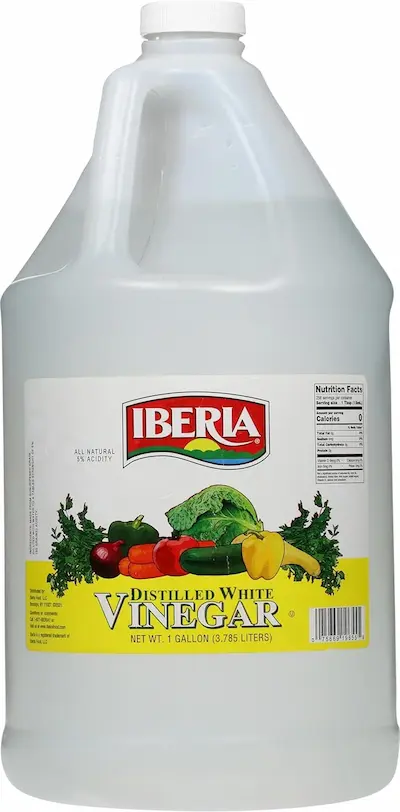
The cheapest fix is sitting in your pantry: white distilled vinegar.
This article covers the three most common dishwasher failures, exactly how vinegar fixes each one, and when a self-cleaning cycle alone is not enough. The approach is based on the same food-safe chemistry we cover in our Natural Cleaning Guide — applied specifically to your dishwasher.
Failure Scenario 1: The Smelly Dishwasher
What you notice: A sour, musty, or rotten smell when you open the dishwasher door — especially after a cycle finishes and you don't open it immediately.
What's actually happening: Food particles that escaped the filter are trapped in the sump area, spray arms, or rubber door seal. In the warm, damp environment of a finished cycle, bacteria and mold feed on this organic residue and produce the smell.
The Fix: Vinegar Self-Cleaning Cycle
This is the simplest fix and the first thing to try:

- Empty the dishwasher completely — no dishes, no silverware baskets.
- Place 1 cup of undiluted white distilled vinegar (5% acidity) in a dishwasher-safe glass measuring cup or bowl on the top rack. A top-rack position ensures the vinegar is distributed gradually through the wash cycle rather than draining immediately.
- Do not add detergent. The vinegar and detergent would neutralize each other — detergent is alkaline, vinegar is acidic. Running them together wastes both.
- Select the hottest, longest cycle on your machine — usually labeled Heavy, Pots & Pans, or Sanitize. The extended hot water plus vinegar is what dissolves the organic residue.
- Run the full cycle. Keep the dishwasher closed for the entire duration.
After the cycle finishes, open the door and sniff. If the smell is gone, a monthly vinegar maintenance cycle is all you need going forward. If the smell persists — or returns within a week — you need the deeper clean covered in Scenario 3.
Why this works: Vinegar's acidity (pH 2.4) breaks down the alkaline compounds in food residue and disrupts bacterial cell membranes. The hot water (typically 130-140°F / 55-60°C on a Heavy cycle) provides the thermal action. Together, they dissolve what detergent alone left behind.
When the Self-Cleaning Cycle Fails
If the smell comes back within a week or two, the issue is trapped debris that the free-flowing vinegar wash cannot reach. See Scenario 3 for the targeted deep clean.
Failure Scenario 2: Cloudy or Spotty Glassware
What you notice: Glasses come out with white spots, a hazy film, or an opaque white layer that does not wash off with a second cycle.
What's actually happening: This is hard water — calcium and magnesium minerals in your water supply. When water evaporates off glass during the drying cycle, dissolved minerals are left behind as a white deposit. Over time, repeated mineral deposition can turn into a cloudy film that standard detergent cannot remove.
The Fix: Vinegar as Rinse Aid
The most effective long-term solution is to use white vinegar as your rinse aid:
- Empty the rinse aid dispenser of any remaining commercial rinse aid first (they do not mix well).
- Fill the compartment with undiluted white distilled vinegar (5% acidity). The machine dispenses it automatically in the final rinse cycle — typically undiluted vinegar.
- Adjust the rinse aid setting on your dishwasher. Start at a mid-range setting (usually 3-4 on a 1-6 dial) and adjust up if spotting persists or down if you see residue.
Vinegar works as a rinse aid through the same mechanism as commercial products: it lowers the surface tension of water so it sheets off dishes rather than beading into droplets that leave mineral spots when they dry. The difference is that vinegar costs approximately $0.02 per fill versus $0.30-0.50 for commercial rinse aid (based on national average retail pricing at time of writing).
The Quick Fix for Already-Cloudy Glasses
For glasses that are already cloudy:
- Soak them in undiluted white vinegar for 15-30 minutes.
- Scrub with a non-abrasive sponge.
- Re-wash in a normal dishwasher cycle.
If the cloudiness does not clear after a vinegar soak, the glass is etched — the minerals have permanently damaged the glass surface. This typically happens with inexpensive glassware that has been through many cycles with hard water and inadequate rinse aid. Softened water or consistent vinegar rinse aid prevents it going forward.
For the full comparison of vinegar versus other methods for hard water, see our guide on Vinegar vs Bleach vs Baking Soda for Hard Water Stains.
Failure Scenario 3: Clogged Spray Arms & Greasy Interior
What you notice: Dishes come out with food still stuck on them, water pressure from the spray arms seems low, or you can hear the spray arms spinning but not hitting all the dishes. The interior has a greasy film.
What's actually happening: Over months of use, two things accumulate inside any dishwasher: hard water mineral scale inside the spray arm holes (narrowing the jets), and a greasy biofilm on the interior walls and heating element. The monthly vinegar cycle helps, but if you have never manually cleaned these parts, a one-time deep clean is needed.
The Fix: Deep Clean — Filter, Spray Arms, and Seal
This takes about 30 minutes and requires minimal tools:
Step 1: Clean the filter
Remove the filter assembly (typically at the bottom center of the dishwasher — twist and lift). Rinse it under hot running water. Use an old toothbrush dipped in undiluted vinegar to scrub the mesh screen and any crevices. The goal is to remove every visible food particle. Reinstall.
Step 2: Clear the spray arm jets
Remove the spray arms (typically held by a retaining nut or clip — check your manual). Hold them under a bright light and look at each small hole. If any are clogged with white mineral deposits, use a toothpick or a straightened paper clip to clear them. Rinse with hot water. Wipe the underside of the spray arm where it rotates on the mounting hub — mineral scale here creates friction that slows or stops rotation.
Step 3: Wipe the rubber door seal
The rubber gasket around the door, especially the pleated sections at the bottom corners, trap food debris and moisture. Wipe the entire seal with a cloth soaked in undiluted white vinegar. Pay extra attention to the bottom corners where standing water collects between cycles. If the seal has visible mold spots, leave the vinegar-soaked cloth on for 15 minutes before wiping.
Step 4: Run the vinegar self-cleaning cycle
After manually cleaning the components, run the same vinegar self-cleaning cycle described in Scenario 1. This final step ensures any remaining scale or film in internal channels is dissolved.
Maintenance Schedule
Once you have solved the immediate failure, keep your dishwasher running well with this minimal schedule:
| Frequency | Task | Method |
|---|---|---|
| Every cycle | Rinse aid | Fill compartment with undiluted white vinegar |
| Monthly | Self-cleaning cycle | 1 cup vinegar on top rack, hottest cycle, no detergent |
| Quarterly | Filter inspection | Remove and rinse filter; clear if food visible |
| Yearly | Deep clean | Spray arm removal + seal wipe + filter scrub + vinegar cycle |
What Not to Do
Use vinegar and bleach in separate cycles. If you have been using a bleach-based dishwasher cleaner, wait one full cycle (water only) before switching to a vinegar cycle. Mixing them creates chlorine gas — a respiratory hazard.
Never mix vinegar and baking soda in the same cycle — they cancel each other out. This is the most common mistake. Many people assume combining an acid (vinegar) and a base (baking soda) creates a super-cleaner. In reality, they neutralize each other: vinegar (acetic acid, pH 2.4) + baking soda (sodium bicarbonate, pH 8.5) → sodium acetate + water + CO₂ gas. The result is salt water with negligible cleaning power. CH₃COOH + NaHCO₃ → CH₃COONa + H₂O + CO₂. Acid-base neutralization produces sodium acetate (weak salt), water, and carbon dioxide. The cleaning power of both ingredients is destroyed. They should always be used in separate cycles to maximize both: vinegar first (dissolves mineral deposits, disrupts bacterial cell walls), then baking soda in a second short cycle (physical abrasion + neutralizes odors).
Remove all dishes before starting a vinegar cleaning cycle. Vinegar can affect the glaze on some ceramic dishes and the finish on aluminum or non-stick cookware. Always run the cleaning cycle empty.
Use only white distilled vinegar in the rinse aid compartment. White distilled vinegar (5% acetic acid) is purified with no residual organic matter — ideal for appliance cleaning. Apple cider vinegar (4-6% acidity) contains sugars, organic compounds, and sediment from fermentation. When heated, these sugars caramelize and leave a sticky brown residue on interior surfaces and seals, trapping more debris. Cleaning vinegar (6% acidity) is too strong for the rinse aid system and may damage internal plastic components over time. Stick with white distilled vinegar at 5%.
When Vinegar Is Not Enough
Vinegar handles mineral deposits, odors, and mild biofilm. It cannot fix:
- A broken drain pump or clogged drain hose — if water remains standing in the bottom of the dishwasher after a cycle, the issue is mechanical, not chemical.
- A failed heating element — if dishes dry poorly and water does not get hot, the sanitization and cleaning power of any method is reduced.
- Etched glassware — once the glass surface is permanently damaged by hard water, no cleaner can restore it. Prevention through rinse aid is the only solution.
- Severe mold inside the door panel — if mold has penetrated the insulation layer inside the door (common in front-loader dishwashers with poor drainage), professional disassembly is required.
For most common dishwasher issues — smell, spots, and reduced washing performance — a $0.25 cup of white vinegar is the most effective solution. For the full breakdown of when to use vinegar versus baking soda versus hydrogen peroxide across your entire household, see our Vinegar vs Baking Soda vs Hydrogen Peroxide comparison.
Related Reading
- Natural Cleaning Guide: Vinegar & Baking Soda — The foundational chemistry guide for all vinegar-based cleaning
- Vinegar Cleaning Ratios Chart — Quick-reference dilution ratios for every cleaning task
- Vinegar in Laundry — How to use vinegar safely in your washing machine
- Vinegar vs Baking Soda vs Hydrogen Peroxide — Which cleaner belongs on which mess
- Cost of DIY Cleaner vs Store-Bought — The annual savings of switching to vinegar-based cleaning
- Energy & Appliances Hub — Compare the energy cost of running your dishwasher versus hand washing