
Suzanne Williamson, RD
Registered dietitian and founder of Frugal Organic Mama. I cooked on gas for fifteen years before switching to induction. The transition required replacing about half my cookware and adjusting to a fundamentally different cooking feel. Here's what I actually found — including what I miss about gas and what I don't.
⚡ What does your current stove actually cost per hour?
Enter your appliance wattage (or BTU rating) and local energy rate — the calculator gives you a real cost to compare methods.
The gas vs electric debate has been running for decades. Induction has recently joined it with enough market penetration to make the three-way comparison worth doing seriously.
Most guides on this topic get distracted by performance claims and miss the energy math. Most energy math guides ignore the efficiency differences that make the per-hour cost comparison misleading. And almost all of them underweight the indoor air quality issue that has become significantly harder to ignore since 2022.
This guide covers all three — with real numbers.
How Each Technology Works
Understanding the mechanism explains the efficiency and performance differences.
Gas burns natural gas or propane at a burner, producing a flame that transfers heat to the cookware through direct contact and radiated heat. The flame heats the air around the pan as much as it heats the pan itself. This is why gas is relatively inefficient — a large fraction of the energy heats the kitchen, not the food.
Electric coil passes electrical current through a metal coil, which heats through resistance. The hot coil transfers heat to the pan through direct contact. Better than gas for efficiency (less heat lost to air), but the coil must heat up before it heats the pan, and it retains heat after you turn it off — meaning it continues cooking even after you reduce or cut power.
Induction uses an electromagnetic field generated by a copper coil beneath the glass surface to create electrical currents (eddy currents) directly within the ferromagnetic cookware. The pan itself becomes the heating element. The surface of the cooktop stays relatively cool — only the pan gets hot. This eliminates almost all heat loss to the surrounding air and produces the highest efficiency of the three.

The Efficiency Numbers: Why Per-Hour Cost Is Misleading
The energy transfer efficiency of each method:
- Gas: 32–40% of energy reaches the food
- Electric coil: 65–75%
- Induction: 85–90%

This means to deliver the same amount of heat energy to food, gas must produce roughly 2.5× more raw energy than induction. A gas burner running at 10,000 BTU/hour delivers about 3,500–4,000 BTU/hour of useful cooking heat. An induction burner drawing 1800W delivers about 1,530–1,620W of useful cooking heat.
The practical consequence: identical cooking tasks take less time on induction than gas, even at equivalent wattage settings. Water boils faster. Sauces thicken faster. The real cost comparison must account for this — not just energy price per unit, but energy units actually consumed to complete the cooking task.
The Real Cost Comparison
At national average US residential energy prices (electricity approximately $0.175/kWh as of 2026, natural gas $1.10/therm). Actual rates vary significantly by state — from $0.12/kWh in Louisiana to $0.42/kWh in Hawaii — so use the Cooking Energy Calculator with your local rates for a number that's relevant to your situation:
| Task | Gas | Electric coil | Induction |
|---|---|---|---|
| Boil 1 quart water | ~8 min / $0.02 | ~9 min / $0.03 | ~3–4 min / $0.02 |
| Simmer soup 1 hour | $0.08–0.12 | $0.12–0.20 | $0.10–0.16 |
| Sauté vegetables 10 min | $0.02 | $0.03 | $0.02 |
| Annual stovetop cooking (avg household) | $50–90/year | $90–150/year | $70–120/year |

The annual cost difference between gas and induction — the two most-compared options — is typically $20–50 per year for an average household at national average energy prices. This is real money but not a dramatic financial difference. The decision should not be made primarily on energy cost grounds.
The Performance Comparison
Temperature Response
Gas responds immediately to flame adjustment — turn the knob and the heat level changes instantly. This immediate visual feedback (you can see the flame size change) is why many professional cooks prefer gas. The response to turning down the heat is fast; the response to turning it up is equally fast.
Electric coil has significant thermal lag — the coil takes 2–3 minutes to heat up and 2–3 minutes to cool down. Turning the dial to low doesn't produce immediate low heat; it produces gradual heat reduction as the coil slowly loses temperature. This lag makes precise control difficult and makes boil-overs more likely because the coil continues radiating heat after you react.
Induction has the fastest and most precise response of the three. When you reduce the setting, the electromagnetic field reduces immediately and the pan temperature drops almost immediately. When you increase it, the pan heats within seconds. This precision is why induction is preferred for temperature-sensitive cooking: candy making, tempering chocolate, maintaining a perfect simmer.
Temperature Extremes
Maximum heat: Induction wins — a high-power induction burner (3,500W) boils water faster than any residential gas burner. Gas burners in residential ranges top out at 15,000–18,000 BTU/hour; professional ranges go to 25,000–35,000 BTU.
Minimum heat: Induction wins — it can maintain genuinely low simmer temperatures (140–160°F) that gas cannot reliably hold. A gas burner at minimum produces more heat than needed for delicate simmering; the pilot can even go out at very low settings on older ranges. Induction at minimum setting holds a temperature steadier than any other method.
Wok cooking: Gas wins clearly. Wok cooking requires very high heat, open flame to char vegetables and create "wok hei" (breath of the wok), and the ability to toss food above the flame. Induction cannot replicate wok hei. Electric cannot either. If wok cooking is a significant part of your cooking, this is the strongest argument for keeping gas.
Surface Temperature
Gas and electric coil: the burner surface gets very hot. Spills bake on, cleaning is difficult.
Induction: the glass surface heats only from contact with the hot pan — a spill on the induction surface from a hot pan will cook slightly, but the surface itself doesn't get cooking-hot. Spills that land away from the pan are easy to wipe up immediately. This is a genuine safety and convenience advantage with young children in the kitchen.
The Indoor Air Quality Issue
This section has become more important since a cluster of studies in 2022–2023 quantified what was previously known anecdotally.
Gas combustion produces:
- Nitrogen dioxide (NO₂): A respiratory irritant associated with asthma development and exacerbation. EPA outdoor standard is 53 ppb annual average; Peak NO₂ concentrations frequently exceed 100 ppb in kitchens without ventilation, compared to EPA 1-hour outdoor standard of 100 ppb.
- Carbon monoxide (CO): Produced even by properly functioning burners; more at ignition and at low settings.
- Fine particulate matter (PM2.5): Combustion byproducts that penetrate deep into lung tissue.
- Methane: Even unburned gas leaks from gas connections and burner seals when not in use. A 2022 Stanford study estimated that US gas stoves leak methane — approximately 0.8% of gas used escapes as unburned methane, equivalent to 500,000 cars annually.
Who should care most:
- Households with children under 5 (respiratory systems still developing)
- Pregnant individuals
- Anyone with asthma, COPD, or other respiratory conditions
- Small kitchens with poor natural ventilation
Who this matters less for:
- Adults without respiratory conditions cooking occasionally with good ventilation
- Kitchens with properly venting range hoods (vented to outdoors, not recirculating)
The ventilation point is critical: a range hood that recirculates air through a charcoal filter removes some particles and odors but does not remove NO₂ or CO. Only a hood that vents to the outdoors meaningfully reduces combustion byproduct exposure. Most range hoods in US homes recirculate.
As a registered dietitian with a focus on family health, this data shifted my personal calculation meaningfully — particularly thinking about cumulative childhood exposure. It is not a reason for alarm about existing gas stoves, but it is a reason to prioritize ventilation and to weight this factor when making a new purchase decision.
Electric and induction produce no combustion byproducts. The health argument for switching is strongest for households with young children in poorly ventilated kitchens.
The Cookware Compatibility Issue
Gas and electric coil: work with all cookware materials — stainless steel, aluminum, copper, cast iron, non-stick, ceramic, glass (on electric only).
Induction: requires ferromagnetic cookware only.
The magnet test: Hold a refrigerator magnet to the bottom of the pan. Strong attraction = works on induction. Weak or no attraction = will not work.
Works on induction:
- Cast iron (all types)
- Carbon steel
- Most stainless steel (18/0 grade — check for "induction compatible" label)
- Enameled cast iron (Le Creuset, Lodge enamel)
Does not work on induction:
- Pure aluminum
- Copper
- Most non-stick (unless specifically made with magnetic base)
- Glass and ceramic
- 18/10 stainless steel (the most common grade — check your pans)
The real cost of switching: If you're switching from gas to induction with an existing cookware collection, budget $100–400 to replace incompatible pieces. Cast iron and stainless steel are typically compatible. A full set of non-stick aluminum pans would need to be replaced.
My actual experience switching: I kept my cast iron (all worked), replaced my aluminum sauté pan ($45 for a compatible stainless alternative), and kept my stainless stockpot (it was compatible). Total replacement cost: $45. If you have a larger collection of aluminum or non-stick cookware, the cost can be significantly higher.
The Equipment Cost Comparison
| Type | Entry range | Mid-range | High-end |
|---|---|---|---|
| Gas range (freestanding) | $500–800 | $800–1,500 | $2,000–5,000+ |
| Electric coil range | $350–600 | $600–1,000 | $1,000–2,000 |
| Electric smooth-top range | $500–800 | $800–1,500 | $1,500–3,000 |
| Induction range | $700–1,000 | $1,000–2,000 | $2,000–5,000+ |
| Portable induction burner (single) | $35–80 | $80–150 | — |
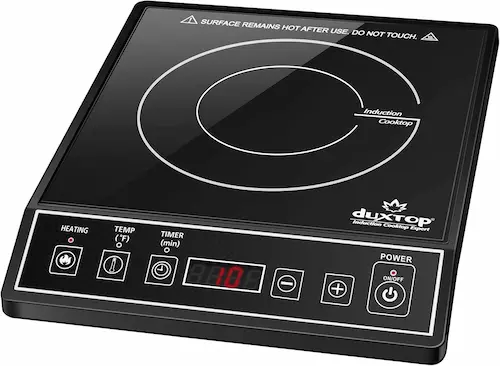
The portable induction burner option: A single portable induction burner ($35–80) is an excellent way to test induction compatibility with your cookware and your cooking style before committing to a full range replacement. Plug into any standard outlet, use on any counter surface. I used one for six months before replacing my range.

Who Should Choose What
Choose gas if:
- You do significant wok cooking or other high-heat techniques requiring open flame
- Your local natural gas is substantially cheaper than electricity
- You're in a rental and cannot change the connection type
- You prefer visual flame feedback for cooking control
Choose induction if:
- You have or are buying compatible cookware (cast iron, stainless)
- Precision temperature control matters to you
- You have young children or household members with respiratory conditions
- Your kitchen ventilation is limited
- You're concerned about indoor air quality from combustion
Choose electric coil if:
- Budget is the primary constraint (cheapest purchase price)
- You have existing cookware you don't want to replace
- You're in a rental or can't install gas or induction
- Cooking performance is not a high priority
The honest verdict from someone who switched: The cooking performance difference between induction and gas is real but smaller than the enthusiast community claims for most everyday cooking. What I don't miss about gas: the cleaning difficulty, the ventilation concerns, and the thermal lag when turning down heat quickly. What I do miss: wok cooking, the visual feedback of flame size, and being able to cook during a power outage.
Want the real cost at your local energy rates?
National averages don't apply everywhere — enter your actual gas and electricity rates for a comparison that's relevant to your situation.
Related Reading
- Air Fryer vs Oven Energy Cost — The same efficiency framework applied to air fryer vs conventional oven
- Microwave vs Oven Baked Potato — Energy cost, taste, and nutrition comparison of microwave vs conventional oven for the same dish
- Does Preheating the Oven Use More Energy? — The preheating energy question with real wattage data
- 2026 Home Energy Tax Credits — Federal tax credits for switching to electric appliances including induction ranges
- Power Outage Food Safety — One downside of electric and induction: no cooking during outages