The jar comes off the shelf with a little too much ease. You flip it over, and there it is — the lid flexes under your thumb instead of holding firm. Or maybe the seal held fine, but the liquid inside has gone milky. Or the green beans have darkened to a muddy olive. Your stomach drops. What did I do wrong? Is my family going to get sick?
I've been in that kitchen. I've stood at the counter with a jar in each hand, comparing, wondering, trying to remember exactly which batch had the extra-long processing time and which one I rushed. And after years of validating recipes against the USDA Complete Guide to Home Canning and the NCHFP guidelines, I can tell you the first thing you need to know:
A failed or suspicious jar is data, not a verdict.
Every canning failure traces back to a handful of measurable variables — processing temperature, processing time, and seal mechanics. Once you learn to read the symptoms as a diagnostic checklist, troubleshooting stops being a crisis and becomes a repeatable process. And the most important safety rule comes first, so I'm putting it at the very top where it belongs.
⚠️ SAFETY FIRST — Read This Before Anything Else
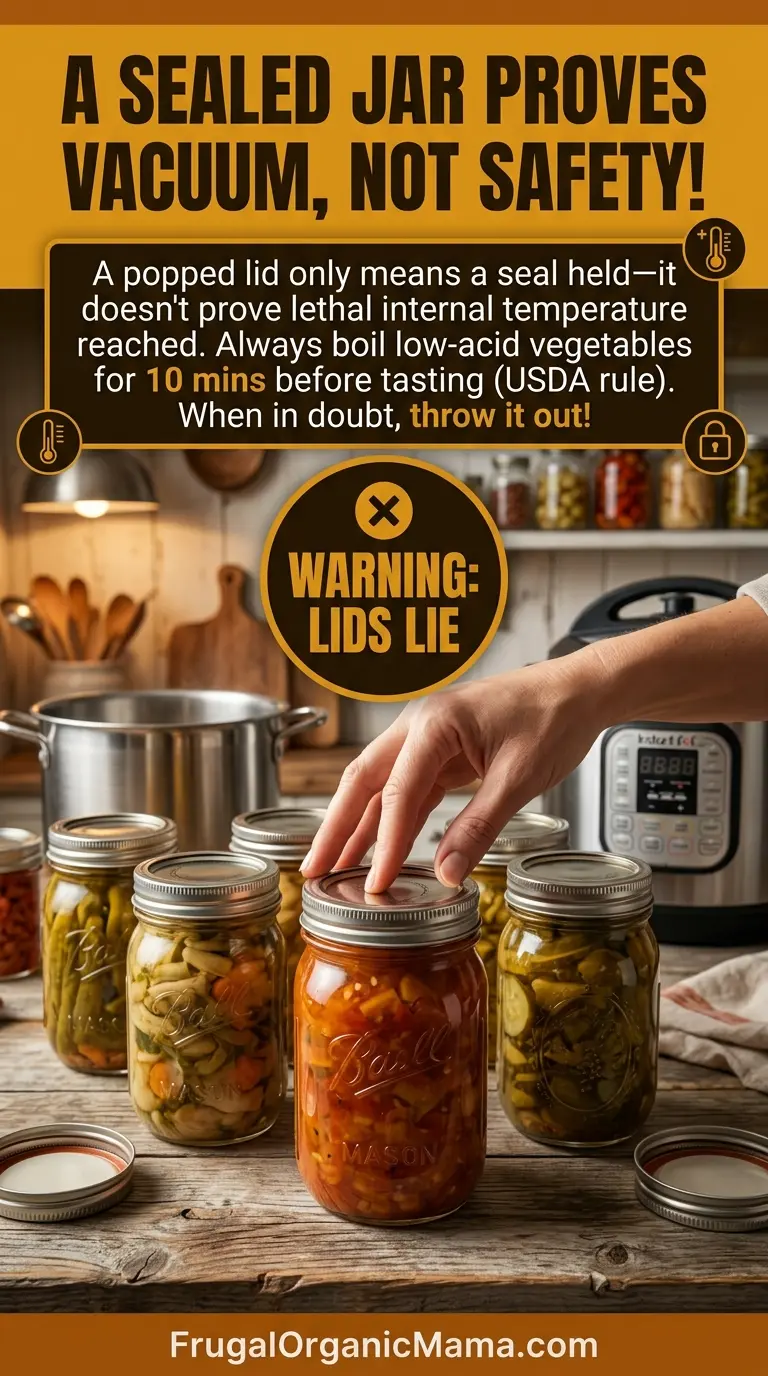
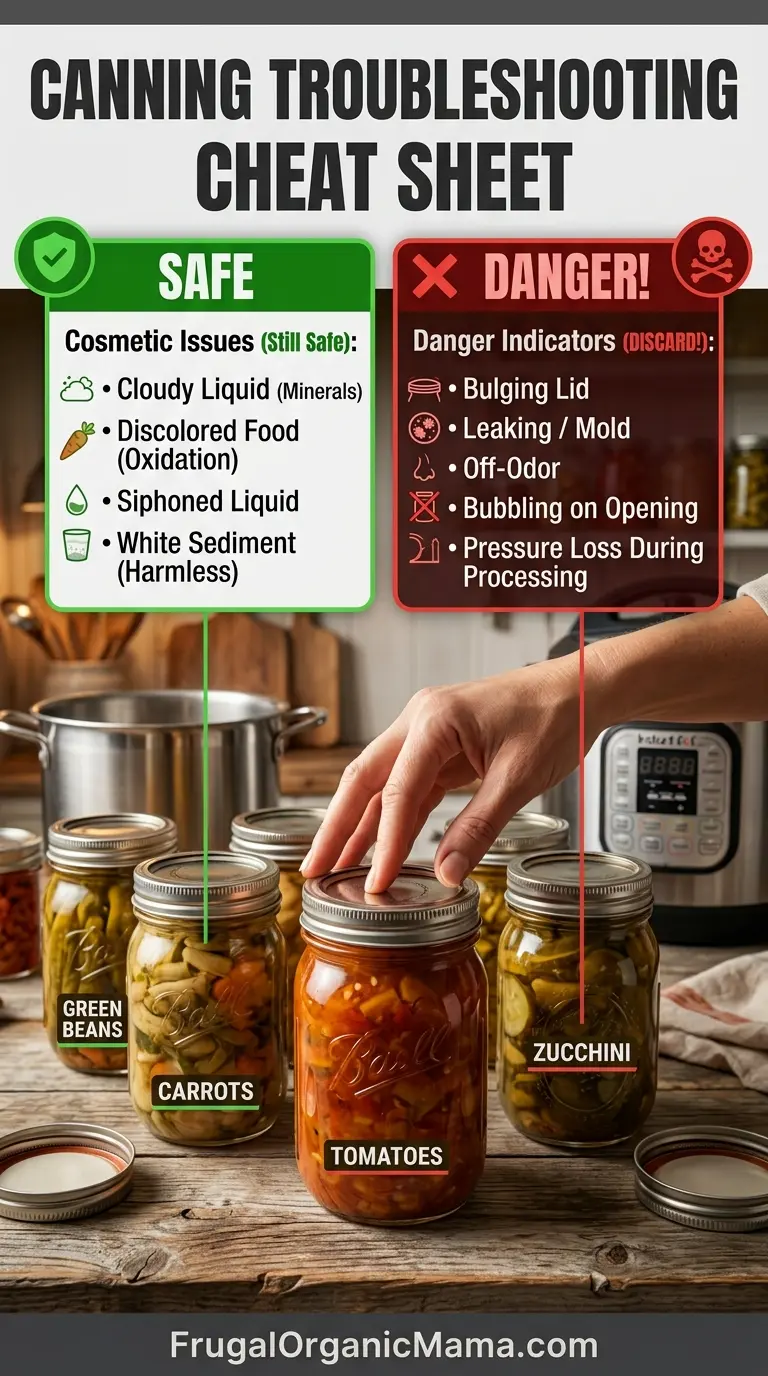
Discard any jar with a bulging lid, leaking, off-odor, mold, or liquid that bubbles when opened. Never taste-test for safety.
Boil all home-canned low-acid vegetables for 10 minutes (15 minutes above 5,000 feet) before tasting. This is the USDA rule, and it's non-negotiable.
When in doubt, throw it out.
The reason this comes before every other diagnostic step is simple: a sealed jar means vacuum, not safety. That popped-down lid only tells you the seal held. It does not tell you whether the food inside reached a lethal internal temperature and held it long enough to destroy dangerous organisms. A jar can seal perfectly and still contain spoiled food. So we check safety first, cosmetics second.
Quick Diagnostic Table
| Symptom | Likely Cause | Check | Fix |
|---|---|---|---|
| Lid flexes / never popped | Seal failure — wrong headspace, reused lids, non-Mason jars | Press center of lid; check headspace with a ruler | New lids, correct headspace, Mason jars only |
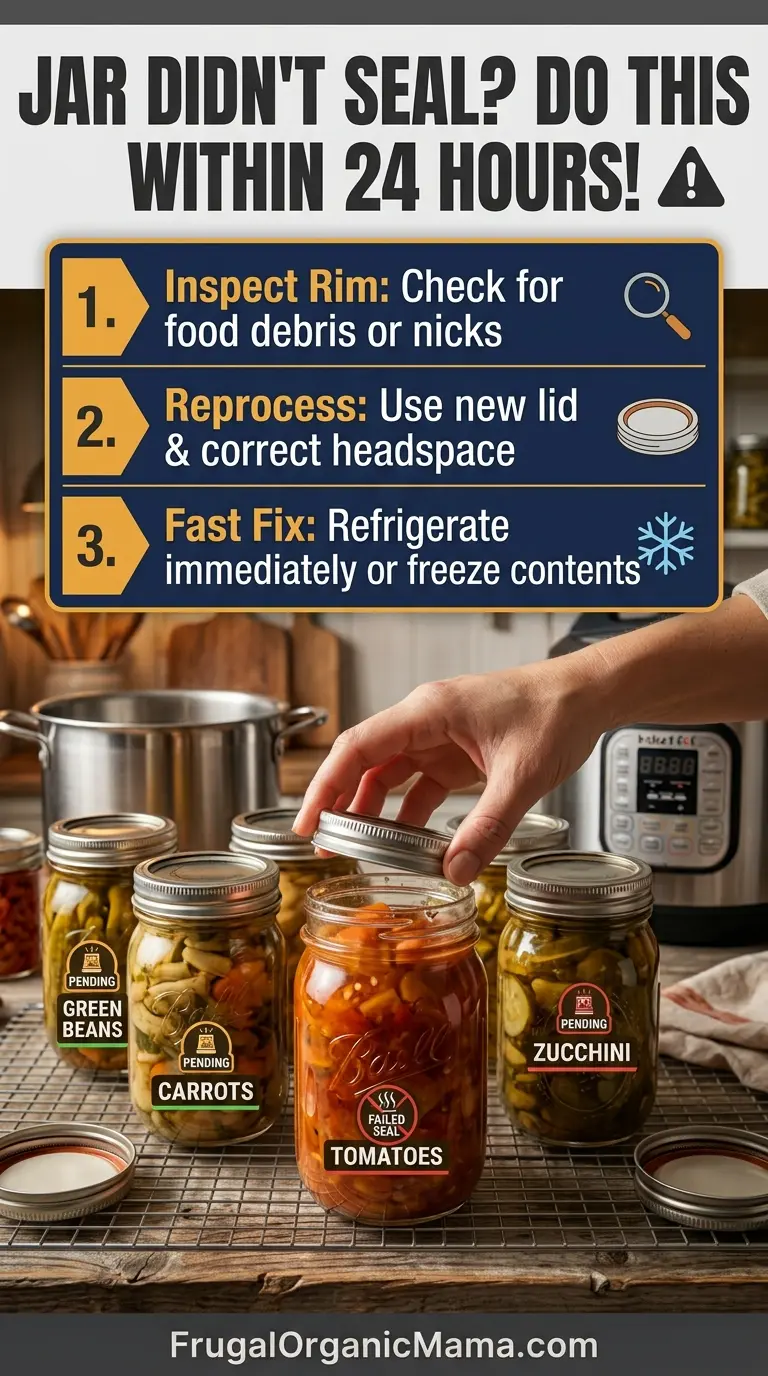
| Jars didn't seal after 24 hours | Same as above + rings left on, too much/little headspace | Wait full 24h; inspect rim for nicks | Re-process within 24h or refrigerate |
| Liquid leaked / siphoned | Overpacking, rapid depressurization, excess headspace | Check packing density; review cooling method | Pack loosely, natural release only, measure headspace |
| Cloudy liquid | Minerals, starch, hard water, fine sediment — cosmetic | Check seal, odor, mold | Safe if no spoilage signs; use filtered water next time |
| Discolored / brown food | Oxidation, over-processing, minerals — cosmetic | Check seal, odor, mold | Safe if no spoilage signs; use ascorbic acid for light fruits |
| Jars cracked | Commercial jars, thermal shock, overfilling | Inspect glass type; review cooling process | Mason jars only, natural cooling, don't overfill |
| Food spoiled / off-smell | Under-processing, water bath for low-acid food, no acidification | Check method and processing time | Discard — fix process next batch |
| Bulging lid | Spoilage — gas production | None — do not open | Discard immediately |
| "Is it safe?" question | Altitude not adjusted, skipped venting, gauge not tested | Verify altitude adjustments, vent time, gauge accuracy | Adjust pressure/time, vent 10 min, test gauge annually |
| Seal failed in storage | Rings left on, rust, silent seal loss | Remove rings, inspect lids periodically | Store rings off, check jars monthly |
Plan the batch right before you start — get your jar count.
The Harvest to Jar Calculator gives exact jar counts for your harvest weight, so you never run out of jars mid-session or overpack the ones you have.
Problem 1: Seal Failures (Jars Didn't Seal or Failed in Storage)
Symptom: The lid flexes when you press the center. It never popped down in the first place. Or it popped down properly, then released — sometimes months later, with no warning.
What's happening: The seal is mechanical. The two-piece lid's sealing compound softens during processing, the vacuum pulls it down against the glass rim, and it hardens in place. When that doesn't happen — or when it happens and then breaks — something in that chain was off.
Here are the usual culprits:
Wrong headspace. Headspace is not a suggestion; it's a measured variable. Too much air left in the jar means too much oxygen, which means the vacuum can't form properly. Too little headspace means food particles get trapped under the rim and break the seal. The USDA headspace standards are:
- Jams and jellies: 0.25 inch
- Fruits and tomatoes: 0.5 inch
- Pickles: 0.5 inch
- Vegetables: 1 inch
- Dried beans: 1 inch
- Meats and poultry: 1 to 1.25 inches
Reused lids. This is the one I see most often, and I understand the temptation — lids are expensive and they look perfectly fine. But the sealing compound on two-piece lids is permanently compressed on first use. It will not re-form a reliable seal the second time. The USDA and NCHFP are unambiguous: new lids for every batch. (The metal screw bands, though, can absolutely be reused if they're not rusted or bent.)
Commercial jars. Those beautiful spaghetti sauce jars from the grocery store have necks that don't match standard Mason jar lid dimensions. Even if the lid seems to fit, you're gambling. Mason jars are manufactured to precise tolerances for a reason.
Rings left on during storage. This is the silent seal-killer. When you leave the screw band on, moisture gets trapped between the band and the lid, rusts the lid, and breaks the seal — sometimes months later, without you ever knowing it happened. The lid looked fine at two weeks, but by four months, the seal is gone and you can't tell by looking.
Torque on the lids. "Finger-tip tight" means exactly that: tighten the band until it stops, then give it a gentle turn. Too loose, and air escapes during processing. Too tight, and air can't escape — which means pressure builds inside the jar and causes siphoning or seal failure.
Diagnosis and fix: Measure your headspace with a ruler. Not eyeballed — measured. Confirm you used new lids. Confirm you used Mason jars. After 12–24 hours of cooling, remove the bands and test the seal by pressing the center of the lid — it should be firm and flat, no flex.
For next batch: Measure, don't eyeball. Headspace, torque, jar type, new lids — every one of these is checkable before the jar goes into the canner. (For a full walkthrough, see our guide on what is headspace in canning.)
Problem 2: Liquid Siphoning / Leaking
Symptom: Liquid boiled out of the jars during processing. You have a ring of food residue on the rims, the canner water is murky, and half the batch never sealed.
What's happening: Siphoning happens when pressure inside the jar pushes liquid out past the lid. Three causes account for almost every case:
Overpacking. Dense foods need room for heat to penetrate and for liquid to circulate. If you cram green beans in to the top of the jar, you've created a solid mass that can't process evenly — and the expanding food forces liquid out. The tested packing densities matter: green beans pack at roughly 2 pounds per quart depending on raw vs. hot pack, and tomatoes at about 2.75 pounds per quart. Loose packing is not wasted space; it's safety margin.
Rapid depressurization. This is the big one. When you dump cold water over a hot pressure canner to speed things up, the sudden temperature drop causes the liquid inside the jars to boil violently — and that violent boil forces liquid out. The USDA method exists for a reason: let the canner cool naturally, wait for the pressure to reach zero, then wait 10 more minutes. Every time.
Excess headspace. Too much air in the jar expands during processing and physically pushes liquid out. This is why the USDA headspace standards are so specific — 1 inch for vegetables, 0.5 inch for fruits and tomatoes, 0.25 inch for jams.
Diagnosis and fix: If the jars sealed despite the siphoning, the food is likely safe — but check the seal carefully, because food residue on the rim is a seal-breaker. Clean the rims thoroughly before processing (wipe with a clean, damp cloth after filling), pack per tested densities, and commit to natural pressure release.
For next batch: If a jar siphons, resist the urge to "fix" it by topping it up with more liquid after processing. Once the jar is processed, it's processed — opening it defeats the entire purpose.
Problem 3: Cracked Jars
Symptom: A hairline crack running up the side, or a jar that simply shatters in the canner. Sometimes you hear it before you see it — that sharp ting from the water bath.
What's happening: Glass cracks when it experiences thermal or mechanical stress it wasn't designed to handle.
Commercial jars are the first suspect. Grocery store jars use thinner glass that's not rated for canner temperatures and pressure. Mason jars are manufactured for exactly this use — the glass composition and thickness are engineered for the thermal and mechanical stress of home canning.
Thermal shock is the second. Hot jars on a cold counter. Cold water splashed over a hot canner. Cold liquid poured into hot jars. Even a small temperature differential can crack glass. The fix is to let temperature changes happen gradually — set jars on a cooling rack, let the canner cool naturally, and make sure your packing liquid is hot when it goes into hot jars.
Overfilling is the third. If you pack a jar too full, the expanding food has nowhere to go, and the pressure pushes against the glass.
Diagnosis and fix: There's no safe way to salvage a cracked jar — discard the jar and its contents. If a jar cracks in the canner, check whether any fragments or liquid contaminated the other jars. If the crack happened during processing and the canner water reached the food in other jars, those jars should be discarded too.
The reassurance: Jar loss is demoralizing, I know. You did the work, you watched the process, and now there's broken glass in your canner. But cracked jars are almost always preventable. Mason jars, gradual temperature changes, proper headspace — that's the whole list.
Problem 4: Cloudy Liquid
Symptom: The canning liquid looks milky or hazy. Maybe there's fine sediment settled at the bottom. You hold the jar up to the light and wonder if something went wrong.
Here's what I need you to hear: Cloudy liquid is almost always cosmetic. It is not, by itself, a sign of spoilage.
What's actually happening:
- Minerals in hard water. Calcium and magnesium precipitate out during processing, giving the liquid a cloudy or milky appearance. This is completely normal and harmless.
- Starch. Foods like corn, potatoes, and beans release starch into the liquid during processing. That starch clouds the liquid.
- Fine sediment. Tiny particles from the food itself settle into the liquid, especially with tomatoes or berries.
- Food above the liquid line. The portion of food sticking above the liquid oxidizes and can darken or contribute sediment.
The safety line: Cloudy liquid + a properly sealed jar + no off-odor + no mold + no bulging lid = safe food. Full stop.
But — cloudy liquid with bubbling when you open the jar, with an off-odor, or with a bulging lid — that's a completely different picture. Those are spoilage signs, and the jar gets discarded.
Diagnosis and fix: Check the safety signs first. If none are present, your food is fine — just not as pretty as the magazine photos. For clearer liquid next time, use filtered or soft water, cut foods uniformly, and keep food below the liquid line.
I want to emphasize this because so many canning guides get it wrong: cloudy does not equal spoiled. You don't throw away a perfectly good jar of green beans because the water had minerals in it. You learn what the minerals did and adjust next time.
(One distinction worth making: cloudy liquid in fermented foods — like a milky brine on sauerkraut — comes from a completely different process, lactic acid bacteria, and follows different rules. Our sauerkraut troubleshooting guide covers that separately.)
Problem 5: Discoloration / Brown or Dark Food
Symptom: Your canned apples look brown. The pears have darkened. The potatoes have a grayish tint. The tomatoes look dull instead of bright red.
What's happening: Like cloudy liquid, discoloration is usually a quality issue, not a safety issue.
- Oxidation. Light-colored fruits and vegetables — apples, pears, potatoes, cauliflower — oxidize when exposed to air. The enzymes in the food react with oxygen and produce brown pigments. This happens fastest during prep, before processing, which is why tested recipes call for ascorbic acid or lemon juice for light fruits.
- Over-processing. Processing longer than the tested time degrades color and nutrients. This is measurable: vitamin C loss during canning typically runs 30–50%, and excessive processing time pushes that number even higher. If you're doubling processing times "just to be safe," you're not making the food safer — you're making it worse.
- Minerals in water. Iron and other minerals can react with the natural pigments in food, causing darkening or dulling. This is the same mechanism that clouds the liquid.
- Food above the liquid line. Exposed food oxidizes and darkens.
The safety line: Discoloration alone is not a spoilage sign. If the jar sealed, there's no off-odor, and no mold — the food is safe, just less visually appealing.
Diagnosis and fix: If discoloration bothers you, address the causes: use ascorbic acid or lemon juice for light fruits per tested recipes, process for exactly the tested time, and keep food submerged below the liquid line. But don't let a brown apple slice send you into a panic — it's a cosmetic issue, not a safety one.
Problem 6: Spoiled / Off-Smell / Bulging Lid
Symptom: A bulging lid. A hiss or bubbles when you open the jar. A sour, fermented, or putrid smell. Mold on the surface. Liquid leaking around the seal.
This is the one section where I will not soften the message: discard the jar. Do not taste it. Do not "just try a tiny bit." Discard it.
What's happening: Spoilage means microorganisms survived processing and multiplied inside the jar. The bulging lid is literally gas pressure from microbial activity. This is the failure mode of under-processing — and it's the failure mode that can include Clostridium botulinum.
Here are the non-negotiable facts:
- Water bath canning reaches 212°F (100°C). That's hot enough to destroy most organisms and enzymes in high-acid food — but not bacterial spores.
- Pressure canning reaches 240°F (116°C). That's the temperature required to destroy C. botulinum spores.
- The safety threshold is pH 4.6. At or below 4.6, the environment is too acidic for C. botulinum to produce toxin. Above 4.6 — which includes green beans, corn, carrots, meat, poultry, and fish — the food must be pressure canned.
- A sealed jar is anaerobic. That means no oxygen. And anaerobic + low-acid + surviving spores = the exact environment where botulism toxin forms.
This is why water bath canning low-acid food is not a "grandma's method" debate. It's a hard line drawn in food science. The USDA Complete Guide to Home Canning exists because people died from the methods that predated it.
Diagnosis and fix: Discard the jar and its contents safely (seal it in a plastic bag before putting it in the trash, so pets or wildlife can't get into it). Then record what went wrong: method, processing time, jar size, altitude. Every spoilage event is a data point — use it to fix the process next batch. (Our comparison of water bath vs. pressure canning covers the differences in detail, and our tomato canning guide includes the acidification table for pints and quarts.)
Problem 7: Is It Safe to Eat? (Safety Checks)
Symptom: The batch looks fine. Jars sealed, liquid clear enough, color normal. But you're not sure you processed it right, and now you're standing in the kitchen wondering whether dinner is safe.
This is the most important question in home canning, so let's run the diagnostic checklist in order.
Check 1: Did you adjust for altitude?
Most recipe books silently assume sea level, and this is one of the most routinely skipped safety steps. Water boils at lower temperatures at altitude, which means your canner runs cooler than the tested conditions unless you adjust.
- Water bath canning: Increase processing time by altitude — add 5 minutes at 1,001–3,000 ft, 10 minutes at 3,001–6,000 ft, 15 minutes at 6,001–8,000 ft, and 20 minutes at 8,001–10,000 ft above sea level.
- Pressure canning with a dial gauge: Increase pressure once you're above 2,000 feet. For green beans, for example, the base pressure is 11 lbs at 0–2,000 feet, then 12 lbs at 2,001–4,000 feet, 13 lbs at 4,001–6,000 feet, and 14 lbs at 6,001–8,000 feet. Processing times stay the same; only pressure changes.
- Pressure canning with a weighted gauge: Use 15 lbs above 1,000 feet.
Altitude adjustment is not a refinement. It's the difference between reaching 240°F and not reaching it.
Check 2: Did you vent the canner for a full 10 minutes?
The venting step is what purges air from the canner so that the gauge reads true steam pressure. If you skip it or shorten it, you're looking at a false pressure reading — the gauge says 11 lbs, but the air-steam mixture inside is at a lower temperature. Under-processing, every single batch.
Check 3: Is your gauge accurate?
Dial gauges drift. The USDA recommends testing them annually at your county extension office. A gauge that reads 2 lbs high means you're processing at 2 lbs less than you think, every batch, all season. (Weighted gauges don't have this problem — they're mechanical and can't drift.)
Check 4: Did you boil before tasting?
This is the rule that catches what visual inspection can't. The USDA requires boiling home-canned low-acid vegetables for 10 minutes (15 minutes above 5,000 feet) before tasting. The reason is blunt: botulism toxin is odorless, colorless, and tasteless. You cannot see it, smell it, or taste it. Boiling at 212°F for 10 minutes destroys the toxin — it's the only home-kitchen method that reliably does so.
If you can't answer yes to all four checks, the jar goes in the discard pile. (Our explainer on USDA canning guidelines walks through the full rule set, and how to can green beans shows the altitude-adjusted process on a real low-acid food.)
The Cultural Context Nobody Talks About
I need to say something that doesn't fit neatly into a troubleshooting table.
American home canning carries a "grandma did it this way and we all survived" tradition. I understand why that's persuasive — family history feels like evidence. But survivorship bias is not a food-safety method. The people who got sick from open-kettle canning, oven canning, or steam canning low-acid foods aren't around to tell their stories. The ones who survived are, and their survival proves only that they were lucky, not that the method was safe.
Here's another thing: many pre-1990 methods are now known to be unsafe, and the rules have changed for real reasons. Tomatoes can vary in acidity — some varieties exceed pH 4.6 — so the USDA requires acidifying every batch rather than trusting the variety. The acidification rules many home canners inherited simply don't apply to today's fruit. The USDA and NCHFP test recipes under controlled laboratory conditions so you don't have to guess. The USDA Complete Guide to Home Canning is the single document that would have prevented most of the failures I see in home kitchens — and most home canners have never opened it.
This is why I do what I do. Not to scare you, but to give you the science that keeps your family safe. (If you're still deciding whether to can at all, our guide on freezing vs canning vs dehydrating compares the trade-offs.)
The One Rule That Keeps You Safe
If you remember nothing else from this article, remember this:
The lid is a vacuum meter, not a safety certificate. Only temperature, time, and headspace make canned food safe — the jar itself just tells you whether the seal held.
And when a jar fails or looks wrong, diagnose in this order:
- SAFETY FIRST — bulging lid, leaking, bubbling on opening, off-odor, or mold → discard, never taste-test.
- Seal failure — lid flexes, never popped → check headspace, new lids, finger-tip tight torque, remove rings for storage.
- Cloudy liquid — cosmetic unless paired with safety signs.
- Discoloration — cosmetic unless paired with safety signs.
- Low-acid food (pH above 4.6) — verify pressure canning at 240°F with altitude-adjusted pressure.
- Before eating any home-canned low-acid food — boil 10 minutes (15 above 5,000 feet).
When in doubt, throw it out.
Frequently Asked Questions
Q: Why won't my canning jars seal? A: Seal failure usually traces to four causes: wrong headspace (vegetables need 1 inch, fruits and tomatoes 0.5 inch, jams 0.25 inch), reused lids (the sealing compound is permanently compressed after first use), commercial jars (neck dimensions don't match standard two-piece lids), or rings left on during storage (trapped moisture corrodes the lid and breaks the seal silently). Fix: measure headspace, always use new lids, use Mason jars only, and remove rings after 12–24 hours of cooling.
Q: Is cloudy liquid in canned food safe to eat? A: Yes — cloudy liquid is almost always cosmetic. Minerals in hard water, starch from foods like corn and potatoes, fine sediment, or food above the liquid line can make the liquid look cloudy or milky. It is NOT a spoilage sign by itself. The food is safe if the jar sealed properly, has no off-odor, no mold, and no bulging lid. For clearer liquid, use filtered or soft water next time.
Q: Why is my canned food discolored or brown? A: Discoloration is usually cosmetic too — oxidation darkens light fruits and vegetables (apples, pears, potatoes), over-processing degrades color and nutrients (vitamin C loss typically runs 30–50% during canning), and minerals in water can react with food pigments. The food is safe if the jar sealed, has no off-odor, and no mold. Keep food below the liquid line and process exact tested times to minimize it.
Q: How do I know if my canned food is spoiled? A: Discard any jar with a bulging lid, leaking, off-odor, mold, or liquid that bubbles when opened — never taste-test for safety. Spoilage signs mean the seal failed or processing was insufficient, and the food may contain harmful organisms. Record what went wrong (method, time, altitude) and fix the process next batch.
Q: Can I reuse canning lids? A: No. The sealing compound on two-piece lids is designed for single use — it compresses permanently the first time, so reused lids fail to seal at significantly higher rates. Buy new lids for every batch. The metal screw bands can be reused if they are not rusted or bent.
Q: Why did my jars crack in the canner? A: Thermal shock is the most common cause — sudden temperature changes from hot jars on a cold counter, cold water over a hot canner, or cold liquid into hot jars. Commercial jars also crack because their glass is thinner and not rated for canner stress. Use Mason jars designed for home canning, let the canner cool naturally, and don't overfill.
Q: Do I need to adjust canning for altitude? A: Yes — it's mandatory, not optional. Water boils at lower temperatures at altitude, so water bath times increase with altitude (add 5 minutes at 1,001–3,000 ft, 10 minutes at 3,001–6,000 ft, 15 minutes at 6,001–8,000 ft, and 20 minutes at 8,001–10,000 ft) and pressure canner dial-gauge pressure increases at 2,000+ feet (12 lbs at 2,001–4,000 ft, 13 lbs at 4,001–6,000 ft). Weighted gauges use 15 lbs above 1,000 ft. Skipping altitude adjustment means under-processing, which is the most dangerous silent failure.
Q: Is it safe to can without a pressure canner? A: Only for high-acid foods (pH below 4.6): jams, pickles, fruit, and properly acidified tomatoes. Low-acid foods — green beans, corn, carrots, meat, poultry, fish — must be pressure canned at 240°F, because water bath canning only reaches 212°F and cannot destroy C. botulinum spores. A sealed jar is anaerobic, which is exactly the environment where botulism toxin forms if spores survived.
Q: How long does home-canned food last? A: Properly canned food stays safe indefinitely if the seal holds — but quality declines. For best quality, use high-acid foods (pickles, fruit) within 12–18 months and low-acid foods (meat, vegetables) within 2–5 years. Store in a cool (50–70°F), dark, dry place, label every jar, and check periodically for bulging lids, leaks, or off-odors. (For storage temperature guidance after opening, see the food safety danger zone guide.)
Q: How do I know if I have botulism in my canned food? A: You can't — botulism toxin is odorless, colorless, and tasteless. This is why the USDA requires boiling all home-canned low-acid vegetables for 10 minutes (15 above 5,000 feet) before tasting. Discard any jar with a bulging lid, leaking, off-odor, or mold — but toxin can exist with no visible signs. When in doubt, throw it out. Never taste-test for safety.
Next batch: verify your jar count and packing density.
Overpacking and wrong jar counts cause most siphoning and seal failures. Plan the math before you heat the canner.
Sarah Chen is the Food Safety & Preservation Editor at Frugal Organic Mama. She's a food scientist and fermentation specialist who validates every canning calculator and preservation guide against USDA and NCHFP standards — so you can preserve with confidence, not guesswork.